Field note
The situation
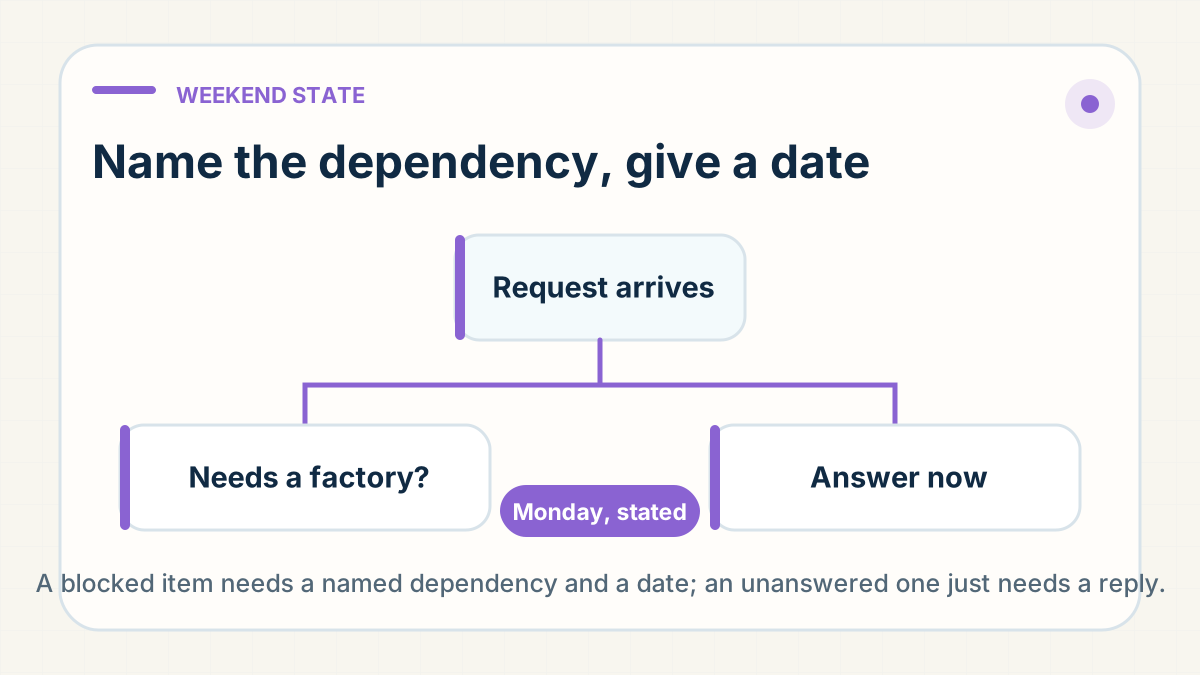
Before the weekend, give every blocked item a named dependency and a date, and answer everything that is merely unanswered. Saturday brought a familiar mix: quotation requests spanning an entire store, customisation questions that needed a factory to answer, an address correction that arrived shortly after a parcel had gone, and a run of ordinary invoice and tracking work. What separated the items that closed from the items that did not was almost entirely whether the answer depended on someone who was working.
Our FAQ answers whether we work at weekends and why a quote can wait until Monday.
- 01Sort by dependencySeparate what you can answer from what a factory must.
- 02Answer what needs no inputPartial progress beats a weekend of shared silence.
- 03Name the closed dependencySay the factory is closed rather than promising to look into it.
- 04Give a specific Monday timeAn expected outcome is better than a disappointing surprise.
Name the constraint instead of absorbing it
Several customisation and pricing questions needed a factory confirmation, and factories were closed. There are two ways to handle that. One is to promise to look into it and let the seller assume the answer is coming today. The other is to say directly that the input is unavailable until Monday, confirm what we can already answer without it, and give the seller a specific time to expect the rest. The second costs nothing and prevents a weekend of silent waiting on both sides.
Quote the shop, but scope the answer
One seller asked for a complete quotation across every product in a store plus a second store's orders, so that a single payment could cover both. That is a reasonable operational request and it is also a large piece of work with several unknown variants inside it. The workable version is a line-by-line breakdown the seller can check rather than a single batch figure, because a total nobody can audit produces a second round of questions anyway.
The change that arrived just too late
A corrected address came through shortly after the parcel had been released. Sometimes that is recoverable and sometimes it is not, and Saturday is the day it is least likely to be, because the people who could intercept it are not there. It is a small, weekly argument for the cut-off table agreed earlier in the week: a published deadline turns a disappointing outcome into an expected one.
Leaving is information, and it should be asked for
The week included two sellers moving on, and both were worth listening to rather than smoothing over. One had brought fulfilment in-house after buying his own stock, and named the reasons directly: parcels ordered in early summer had still not arrived, and our pricing was higher than an alternative. The other had gone to a cheaper provider months earlier and, when asked why, explained that the cheaper price still did not make his product profitable once advertising was counted, so he was changing product rather than provider.
Those are two different lessons wearing the same jacket. The first is a service failure and belongs in the operational record without softening. The second is not about us at all — it is a seller discovering that a product cannot carry its acquisition cost, which no fulfilment price would have fixed. Asking the question is what separates them, and the answer is worth more than the account was.
The practical point for any seller reading this: when you leave a partner, say why. A vague exit teaches nobody anything. A specific one occasionally gets the problem fixed for the next person, and sometimes reveals that the thing you were about to change was not the thing that was wrong.
Weekend work still creates Monday obligations
One quieter Saturday habit is worth naming because it is where handovers usually break. Requests that arrive over a weekend get read, thought about, and then carried in somebody's head to Monday. That works right up until the person who read it is not the person who acts on it.
Write down anything you cannot answer on the day as an action with an owner before the day ends, even when the answer is simply "ask the factory". The cost of doing that is a minute. The cost of not doing it is a seller who followed up politely on Saturday, heard nothing, and follows up less politely on Tuesday.
What the intake register showed
The week's newer conversations again ranged across enquiry, quotation, sample and early onboarding, with only a smaller subset reaching live fulfilment. Reporting them by stage rather than as one headline number stayed the more useful view. The rounded scale context ran from sellers with no paid orders through low-tens live operations, with separate sourcing discussions in the hundreds-of-units range; markets were mainly European with recurring US and UK questions.
Carry only real open items into Monday
Finish the week by separating what is genuinely blocked from what is merely unanswered. A blocked item needs a named dependency and a date. An unanswered one usually just needs someone to write the reply before the office lights go off.