Field note
What was happening
Pin two one-page documents in every client group: a quote legend for every line and a policy sheet for the after-sales terms. The week ran from a closed Sunday into five heavy weekdays of first quotes, onboarding calls, daily invoices and a long after-sales tail. The product mix pooled across apparel, home and lifestyle, beauty, electronics accessories, personalised goods, pet supplies and children's products. The stages ranged from empty stores asking how the flow works, through sellers waiting on their first parcels, to daily-invoice accounts whose support assistants run after-sales lanes in their own groups. Destinations clustered on France, Germany, Italy, the UK, the US, Poland and Japan. These are pooled patterns, not the story of one identifiable account.
The theme of the week
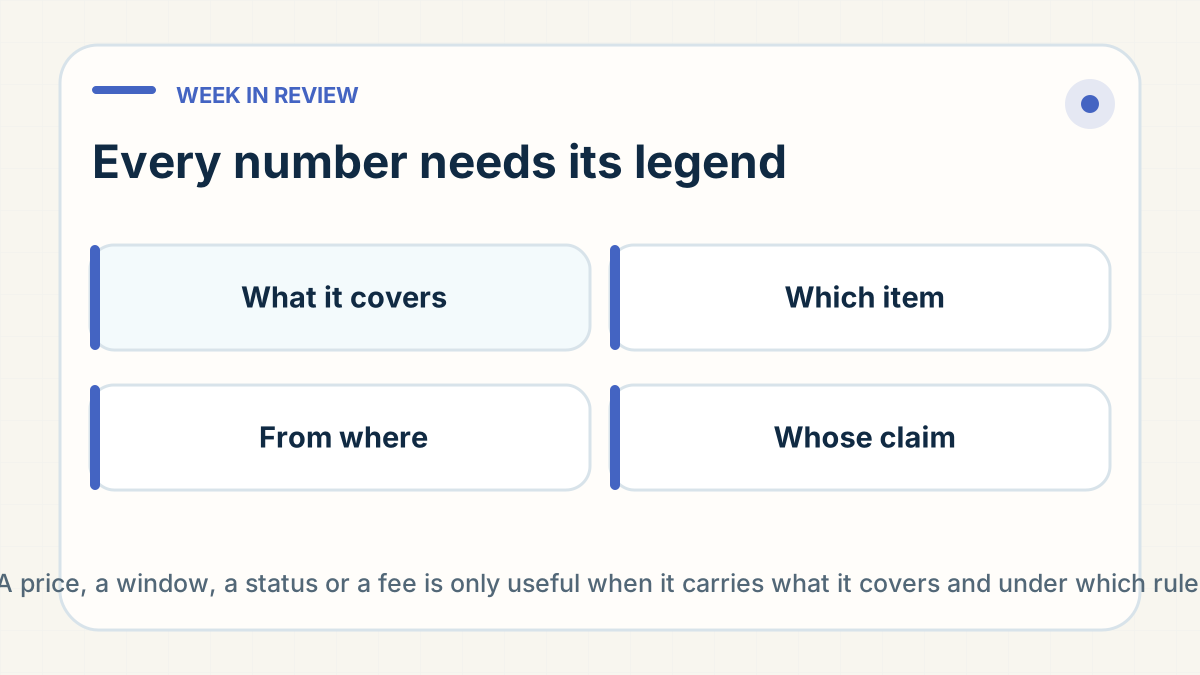
Every number needs its legend. A price, a transit window, a tracking status, a fee, a dispatch date, an after-sales period: each left the desk this week as a bare figure and came back as a question. The figure was only useful when it carried what it covered, for which item, from where, under which rule, and whose claim it was. Every lesson below is that lesson applied to a different number.
A price carries five labels
A price is not a quote until it states the exact variant or component list, the lane and destination, whether shipping, tax and the per-HS-code line sit inside the figure, and the production time before transit starts. Monday showed what a missing label costs. A multi-part hobby kit was quoted on its main unit alone and read as the price of the whole kit; the real figure came a day later and the lead went cold. A throw quoted on the fast lane only looked overpriced until the standard-lane figure sat beside it, at which point the seller chose speed knowingly.
The seller-side test: if you cannot read all five labels from the quote, do not compare it yet. Monday's note walks through the failures, and the new guide on reading a landed-price quote turns the five labels into a sixty-second checklist.
Write the rule, then charge under it
A charge is not a policy until it is written and shared before the first invoice that uses it. Tuesday's disputes were not about whether the rules were fair. Packing error reshipped free, factory defect claimed back from the factory, a charged resend outside the window: each is sound. They surfaced mid-dispute, on an invoice, which is the one place a rule should never appear for the first time. Replacements were created with fresh tracking before the seller had agreed the fee, and one the seller declined had already left. Several new sellers queried a small per-HS-code line on EU quotes in one day because nothing on the quote explained it.
Three steps: define every line item once, in the quote that introduces it; announce a rule change in writing before applying it; quote the fee, get the yes, then create the shipment. Tuesday's note has the cases, and the new guide on who pays for a replacement and when sets out who pays by cause so the rule exists before the first claim.
"The supplier said" is not the same as confirmed
A supplier or carrier statement is a claim until a scan or a document exists, and it should be relayed as one. A personalised-goods seller was told the factory had dispatched and the goods would land within days, then an hour later that it could not dispatch at all. A seller was promised a fresh tracking number for an overseas redelivery that runs on the original number, and chased for two days for something that would never be generated. A first-order seller was given a tracking number before purchase to calm a customer; the label then sat unmoved, which is the complaint it was meant to prevent.
Two answers an hour apart cost more than one slower verified reply, and on a supplier stoppage one structured notice beats a stream of per-order reassurance. Wednesday's note covers relaying claims as unverified and collecting every missing field in one message.
A status reply carries four things
Last scan, cause, next action, date. A bare tracking link, a terse "signed for" or a "will update tomorrow" leaves the seller unable to tell their customer anything. An exception on a Belgium-bound parcel was first answered with a third-party link; the useful reply, incomplete address, returning to the overseas hub, reship for a fee once corrected, came hours later. Two parcels were reported failed while the destination carrier's own page showed both delivered two days earlier. The reply that worked was a Nordic return for non-collection: redelivery fee, deadline, new address and reachable number requested, all in one message.
The other half of the after-sales day was the standing rule: whether a damage photo triggers an automatic resend, whether a charged resend waits for a yes, what is refundable and what is not. One after-sales lead set that in a single message and the seller had nothing further to ask. Thursday's note shows both halves.
Quote the shape of the order
A quote is usable only in the shape the order will take: quantity, per parcel or one consignment, bundle composition, exact item or category example, currency. Three listings asked for in one-, two- and three-piece bundles got single-piece prices. A bulky ride-on was quoted as a single-parcel DDP figure in the high tens of euros when the seller meant a hundred-unit lot to one address, which is a freight quote, not a parcel quote. An in-stock bedding link sent as a category example was searched as an exact item and answered "no stock, high MOQ" until the brief was restated.
The fix sits at intake: ask for the shape before the first figure leaves the desk. Friday's note pairs this with confirming a product's category with the supplier before issuing a shipping verdict in either direction.
Say the number once, the same way
Every number a seller will repeat to a customer, whether a transit window, an express eligibility rule, an after-sales period, a storage rate, an MOQ or a quote turnaround, should be stated once, identically by everyone, in the message where it first matters. A UK marketplace seller whose only question was delivery speed was given three different UK transit figures by three people in a day. A seller with several open cases was told three different lengths, each as "exceeded the period", and still could not tell customers what the period was.
Where the desk answers a window inconsistently, the fix is not to pick the most generous figure in the moment. It is to agree the window, write it into onboarding, and have every reply quote the same line. The evidence window the FAQ already publishes is the model: one number, one place, the same from everyone.
A closed day still owes a next touch
Sunday opened the week with the factories and warehouse shut and the inbox full: after-sales batches from sellers' support assistants, manual link-plus-address orders, a sample chase, a bare question mark. The deliverable on a closed day is not a solution; it is a named next touch. Answer what is process-only now. Name the working day the supplier-dependent part arrives. Publish the cut-off and the reopening time so nobody re-posts the same ticket.
Sunday also set up the week's commercial question: before any number, establish whether the seller wants per-piece dropship or a batch to one address, and why they are switching. Sunday's note adds the smaller rule that a dispatch date should say whose claim it is.
Where the conversations sat
The window held several hundred active conversations. Roughly half were prospects at enquiry or first quote, where the five-label problem and the order-shape problem lived. The rest were live fulfilment groups, and the busiest single threads were after-sales lanes run by sellers' support assistants, where the status-reply gap, the unwritten fee rule and the inconsistent window did their damage. The prospects cost leads; the after-sales lanes cost trust with accounts already paying daily invoices, which is the dearer loss.
What to carry into next week
Two one-page documents, pinned in every client group. The first is a quote legend: what the item reference, unit basis, inclusions, lane and lead time mean on every line we send. The second is a policy sheet: the after-sales window, who pays by cause, whether a charged resend waits for a yes, the no-scan threshold, the lock point for personalised inputs and the coverage hours, each stated once and the same way from everyone. A number that arrives with its legend does not come back as a question.