Field note
The situation
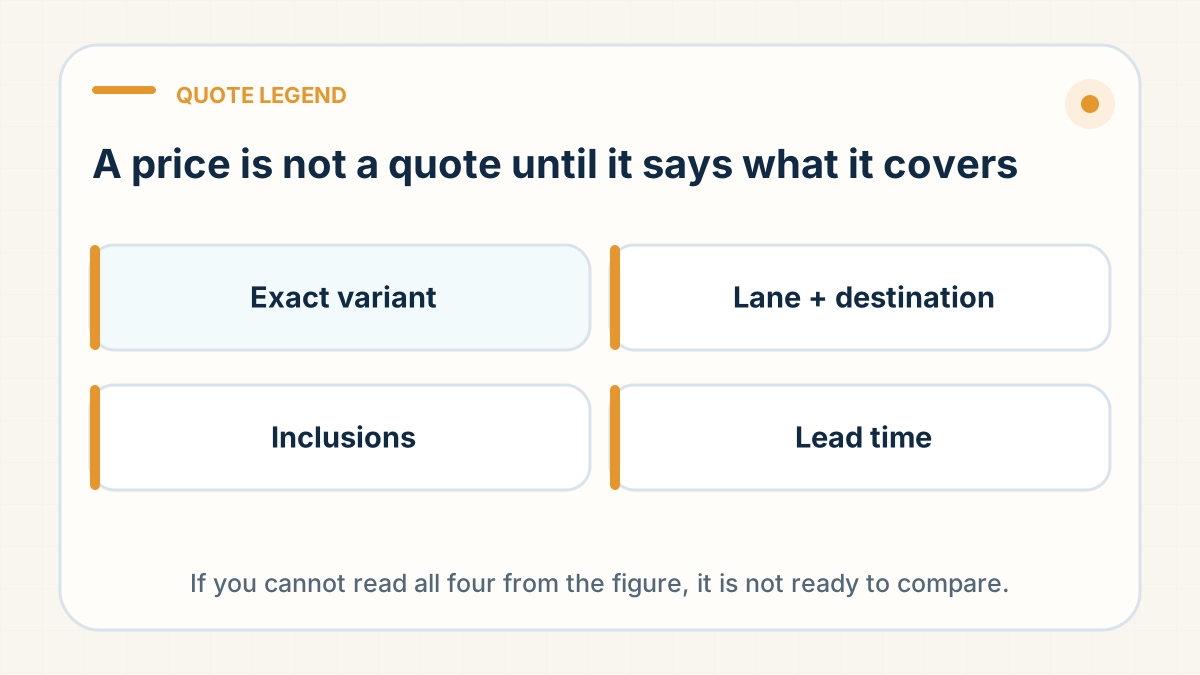
Treat a price as a quote only when it names the variant, lane, destination, inclusions and production time. Monday was the heaviest day of the week. Factories reopened and the desk sent first quotes to new prospects across Europe and the United States, ran onboarding calls, issued the daily invoices and worked a run of delivery exceptions built up over the weekend. Three patterns repeated across unrelated groups: a price sent without saying what it covered, a delivery notice sent without saying what to do, and a rule stated for the first time at the moment it was enforced.
A price carries five labels or it is not a quote
A figure becomes a quote only when it states the exact variant or component list, the lane and the destination, whether shipping, tax and the per-HS-code charge sit inside the number, and the production time before transit starts. A multi-part hobby kit was quoted as "similar product, accessories vary" at a figure that covered only the main unit. The prospect read it as the kit price, said the price was good, and asked three times whether it covered the whole bundle. The real bundle figure came the next day, several times higher, and the lead went cold.
A stationery product that exists in several page counts was quoted twice, neither line saying which version it was. A knitted throw got a fast-lane quote only; against an earlier standard-lane quote it looked overpriced, and the seller asked why. Side by side, the seller chose speed knowingly. An apparel brand asked whether per-piece rates were fully DDP and got a two-word reply; the inclusions list followed two hours later, after the brand had sent a formal list of demands.
The seller-side test is simple: if you cannot read all five labels from the quote, do not compare it with anything yet. How to read a landed-price quote from a China fulfilment agent sets out the five labels in the order to check them, and what a per-HS-code customs charge changes explains the one line most often left out of a European figure. Ask for both relevant lanes with the variant, destination and DDP inclusions stated beside each price.
A delivery exception is not actionable until it names three things
A delivery notice is useful when it says what caused the exception, what the recipient or the seller must now do, and the deadline before the parcel is returned or destroyed. Three US orders came back rejected as "unreachable" with nothing else, leaving the seller unable to tell the customer what to fix. For two parcels stalled at the last mile in Germany and Belgium the notice was a raw carrier contact block, with no word on whether to ask for redelivery or a collection point. A remote-postcode block was told to the store owner only; the support agent who handles the customers found it four days later, and said fairly that problems belong where the customer-service people work.
An Italian parcel returned after unknown-recipient and unreachable-contact failures came with a notice that named the cause, asked for a corrected address and phone, and gave a hard deadline for redelivery. Before acting on an exception notice, check the current carrier scan and what each tracking status means before explaining the event to your customer. A return notice went out for a parcel that tracking showed as delivered, and the seller caught it the next morning.
Ask for the cause, required action, deadline and carrier contact in the exception notice. Make that information available to the support colleague handling the customer. The order issues hub explains the different exception types.
Write the window before the first time you apply it
Every window the operation will enforce belongs in onboarding before it is used: the after-sales period counted from delivery, the no-scan threshold before a resend or refund, the point at which personalised inputs lock, the hold cut-off and the coverage hours. On Monday a seller learned that an after-sales window existed when two replacement requests came back chargeable because the originals had been delivered too long ago. The assistant pushed back that the customer had only just opened the box. The desk held the line, but the window had never been written down for that client, so a sound rule landed as a surprise.
A parcel to Greece with no scan for weeks was refunded only on the second chaser, because no threshold had been agreed that made the first report enough. A custom audio-gift order locked at invoice payment, a reasonable rule stated for the first time at the moment of refusal. A high-volume client wrote out its own processing schedule and received a one-word acknowledgement, which leaves open what "processed" means: picked, or handed to the carrier.
Get the applicable after-sales, order-change and hold windows in writing before the first order. Ask which date supports a decision and resolve any conflicting reply before setting your customer's expectations. The order change and cancellation cut-offs guide explains common lock points.
A quote must explain its own number
Compare a quote only after it states the product, inclusions, destination, service and timing. Confirm the applicable terms during onboarding so an order decision does not depend on a rule first disclosed after payment.
To see the parts a fulfilment quote should state, read how we price fulfilment.