The situation
Between May and July 2026 the order book behind our summer fulfilment data review roughly doubled in monthly volume, in about sixty days. The growth did not come from a wave of new clients; active stores rose only modestly, from the low nineties to around 110. It came from existing stores scaling winning products, which is the harder version of the problem: the same warehouse, the same lanes, twice the parcels, and no onboarding pause in which to prepare.
The record, month by month
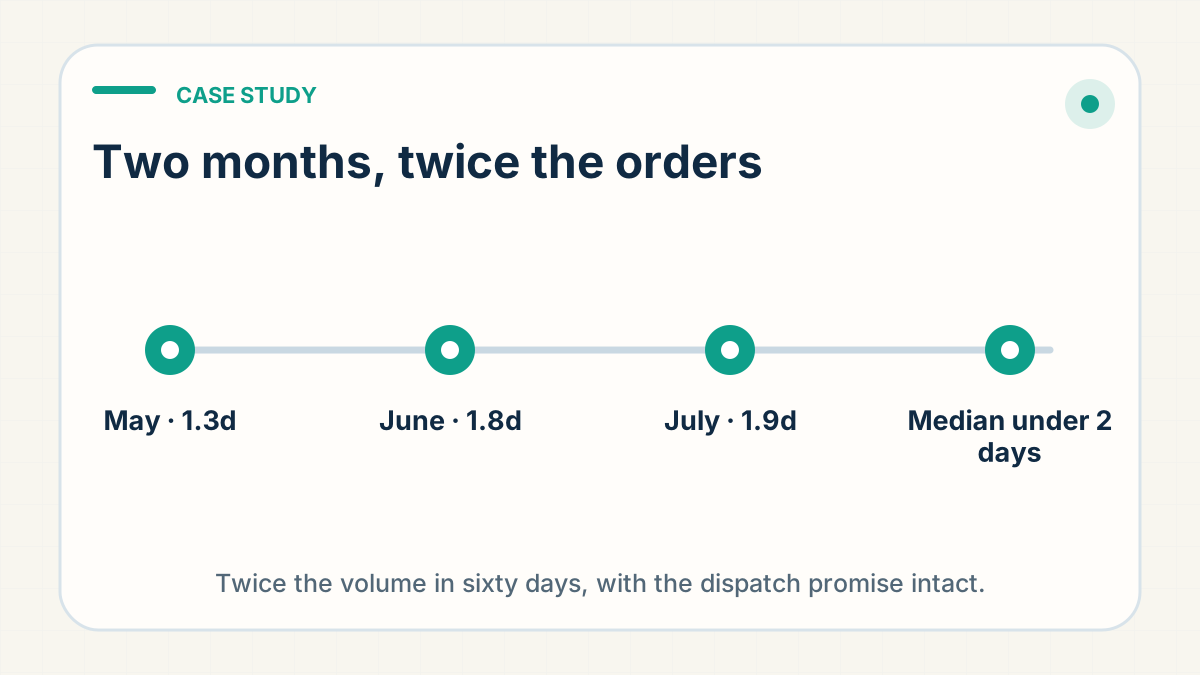
- May — median payment-to-dispatch 1.3 days.
- June — median 1.8 days.
- July — median 1.9 days.
Two things sit in those numbers. The median rose by about half a day and stayed under two days while throughput doubled — the promise a customer actually feels survived intact. And underneath it, the mix shifted: fewer orders left on the same day they were paid, while the slowest orders stayed roughly where they had always been, because that tail was never a packing-bench problem in the first place — it was dominated by orders waiting on stock replenishment.
Throughput results and causal limits
In this period, throughput doubled while the median dispatch time stayed under two days and the slower tail did not expand sharply. This was not a controlled experiment: the separate effects of added picking labour, batch discipline and carrier cut-off timing are unknown, and one summer does not guarantee the next. These are dispatch measurements, not delivery times — the customer's clock keeps running after carrier handover.
Where the strain showed first
The early-warning metric was never the median. It was the same-day share, which gave ground while the median barely moved. A seller watching only the average would have seen almost nothing; a seller watching the shape of the dispatch record saw the queue forming a month before it could have touched the promise. The tail, meanwhile, belonged to purchasing: orders waiting on restock, which is why a practical reorder point matters more to dispatch speed than packing-bench heroics, and why bundle-heavy orders — 58 per cent of this book carried two or more units — raise the per-parcel workload that scaling multiplies.
The honest outcome, and what to ask your own partner
The honest outcome: the promise that mattered — dispatch inside two days at the median — survived a doubling of volume. If you are evaluating a fulfilment partner for scale, that suggests three questions worth asking before the surge, not after. Ask for the dispatch record by month, not a single average. Ask which metric they watch as the early warning, and what they do when it moves. And ask how stock replenishment is triggered, because in this record the orders that waited longest were waiting on purchasing, not packing.
Need one order or route checked?
Worried about an order's tracking? Send us the order number on WhatsApp (wa.link/dropship) and we'll check what's going on.
Check Order on WhatsApp →