From the operations desk
What was happening
Seven complete days: roughly three hundred and fifty distinct conversations carried a publishable moment, roughly eighteen hundred noteworthy moments in all, and roughly eight hundred and fifty direct client questions. About thirty of those questions were still genuinely unanswered when the week closed: a thread-by-thread check found more than half of the questions that looked unanswered were already answered, in the seller's other thread with the same desk or later in the same thread.
Roughly three in five conversations were active fulfilment groups mid-order and roughly one in three prospects still deciding, a tilt towards live fulfilment. France led the destinations, then the United States, the United Kingdom and Germany; roughly two thirds of the destination mentions were European. Home and lifestyle led the product families, then apparel, then beauty, electronics accessories and personalised goods.
Monday was the heaviest day of the week, about a fifth of it alone; Sunday the lightest, and the one day that ran on intake rather than operations; the Saturday came in at roughly two thirds of a weekday. These are pooled patterns, not the story of one identifiable account.
The theme of the week
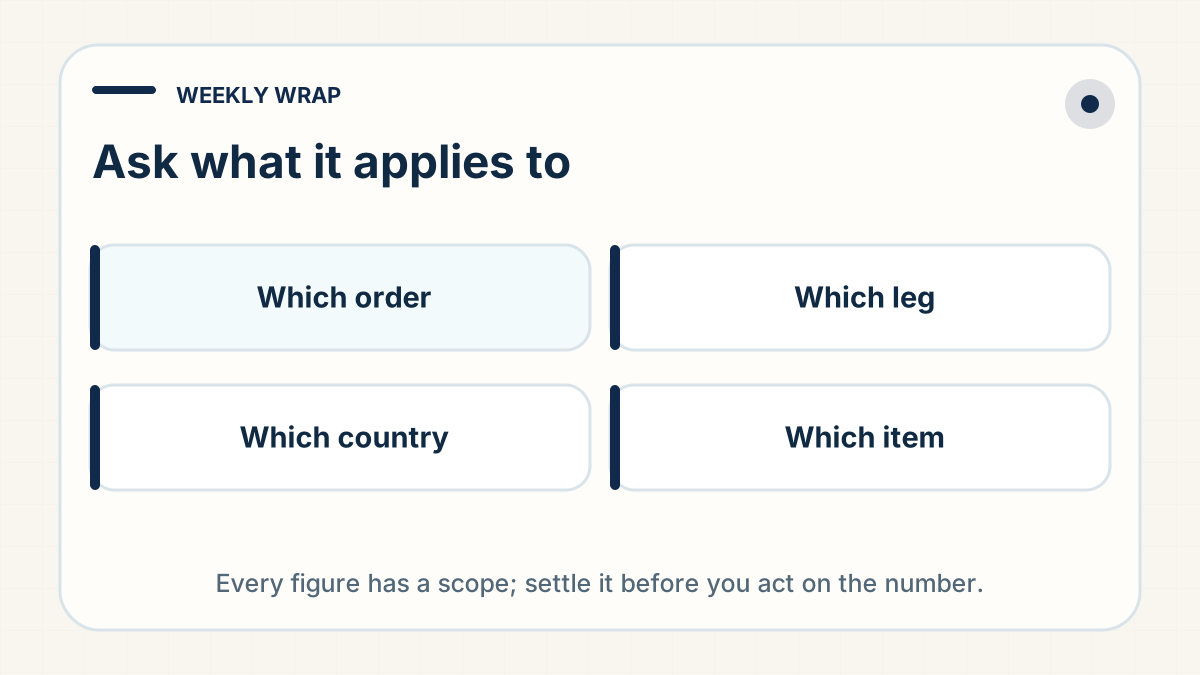
Ask what it applies to. Every figure and every instruction that crossed the desk this week had a scope — which order a change starts on, which leg you own, which country a price belongs to, which item inside a bundle carries the floor, which orders a recorded default covers — and settling that came before the number was worth acting on.
An earlier wrap in this series, Every Number Needs Its Legend, put the labelling duty on whoever sends a figure. This one is the earlier move and the buyer's: the boundary you set before a figure exists, whose object is an order, a leg, a country or an item, not a label.
One prospect exchange made the point inside a day: an all-in total went out with no destination named in the thread at all, and a second quote followed within minutes of the destination finally reaching it — a landed price belongs to one country, so a neighbouring market is a separate line to ask for.
A branding change needs its first order, not its approval date
Approving artwork settles what a parcel will look like, not which parcel is the first to wear it — and the warehouse is left to guess at the gap.
Name the order the new presentation begins on and the artwork version it was approved against — a branding change needs a start point has the week's cases and the rung of the packaging ladder to settle beside them.
The leg into the warehouse is your shipment
Goods a seller buys and sends into an agent's China warehouse travel on a leg neither side has agreed to own, and that silence is what turns an arrival into an argument.
Settle who checks the packed parcel on arrival, who documents it when it arrives damaged or wrong, and when a quoted inbound figure becomes firm, before your supplier posts anything — the arrival is where you check what landed carries the address block and the receiving questions.
Answered twice means it belongs on the record
A question the desk has already settled further up the same thread is not a communication failure but a missing default, and a default is usable only when its exception has an owner and a place the packer will read it.
Ask your partner to read the standing lines held against your account back to you, and which artefact each one lives in — the intake form, the order record or a shared sheet; settle it once and name the exception has the defaults this week earned.
A call in your own language still needs the writing around it
A translated call is worth the record it leaves behind: the terms the seller stated on it — the channel to be reached on, the markets sold into, the legs inside a delivery window — are what the quote that follows has to be read against.
Ask that the recap reach you in writing ahead of the quote, and check it names the lane behind every transit figure it repeats — a translated call needs a written record sets the two documents beside each other.
A minimum belongs to an item, and it has a kind
A supplier floor arrives unlabelled, and the label is the whole question: a stock floor, a customisation floor whose stated reason decides whether order size can move it, a restriction no quantity unlocks, or a volume break that is a target rather than a wall — and in a multi-item order the highest of them sets what the whole order must clear.
Ask for a minimum classification line on every quote, per product: the floor, whether a sample can be bought below it, and which version of the item it was quoted against — ask which minimum you have hit.
Where the week's questions actually sat
Price, quote and minimum-order questions were about a fifth of the week, and product-specific detail — what is in the box, which variant exists, which measurement — another fifth; roughly half of each block is unserved in public, and product detail is the week's largest such body. Branding, packaging and customisation ran at about one in eight, half of it unserved too, and the changeover half has no guide yet.
Tracking sat at about one in eleven and was mostly settled in thread, shipping time and route at about one in fifteen, payment and invoice at about one in twenty — the last the least publishable. The theme with no complete public answer anywhere is evidence collection: who gathers a claim artefact, when, and what to do when it cannot exist.
What to carry into next week
One control, and it is a page rather than a rule: an account defaults sheet, one per account, held where both sides work. The rows this week earned are the packing standard and who names the orders that take its exception; the materials and variants you will not list; which order series maps to which destination, so a chat message cannot outrank the sheet; the order-intake fields in full, as one line; any optional add-on and how the fulfilment side learns an order needs it; the changeover point and artwork version for each branding asset; and the inbound-leg facts.
Three of those lines are values you cannot write yourself: the point at which a quoted inbound figure becomes firm, the lane behind every transit figure, and the acknowledgement target that applies when you raise a quote or an issue — on this desk, the published one-working-day target. Ask for those three in writing, and the sheet answers, line by line, the question this week kept asking in a different place — what does this apply to?