From the operations desk
Four kinds of minimum crossed the desk in one day
This Saturday, the last day of the desk's working week, ran below a weekday's volume, and what it carried was sourcing replies and quotes, not after-sales. Four different kinds of minimum crossed the desk before the suppliers answering finished for the day, and which kind each one was decided what a bigger order could do about it. The cost showed early.
A first-orders apparel seller, handed a floor in the low hundreds the evening before — one colour, mixed sizes permitted — with nothing to say whether it covered the item or only the label-free version he had asked about, asked on Saturday morning whether the product could be bought for only one. No answer to that question came back that day. What arrived twice that afternoon was a per-piece price for two other items he had sent — nothing about the first.
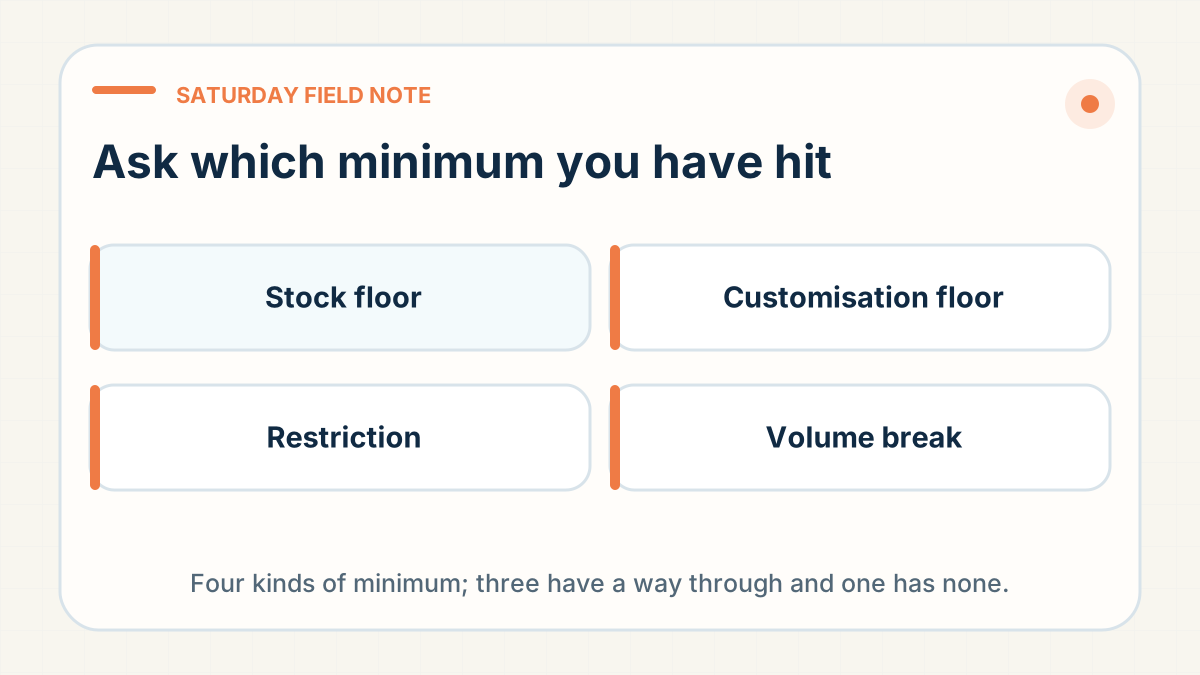
The first kind is a stock floor, and it is not a sampling rule
On a small electronics accessory quoted late that day, the desk relayed a floor of several dozen pieces, mixed colours accepted; the seller asked for one of each candidate variant at the warehouse anyway. The reply said the supplier required that floor for the item, and would check whether a sample could be bought — then came back inside the hour that a single piece could be. One question produced that; the floor itself had not said so.
The second kind belongs to the customisation, and its reason says whether it moves
Custom packaging with a brand name came back at a floor in the low thousands; asked to cut it to a third of that, the supplier answered that the smaller figure would not cover opening a mould. That refused figure was itself the standing floor for a solid-colour run of the second unit in the same comparison — a quantity refused on one version can be the rule on another. The minimum rises with the branding rung you choose, so establish which rung the figure you were handed belongs to.
A prospect planning a personalised line was handed a personalisation minimum of a couple of hundred pieces that morning; late that evening she made the move that moves a customisation floor, asking for a small number of plain, unmarked units instead because the floor was more than she wanted to hold. Her plain-unit answer came back on the Monday, lower but still real, which is why the personalised price, the minimum and the dispatch time each have to be asked for separately.
The third kind is not a quantity, and the fourth is not a barrier
The third kind is not a number. A beauty seller asked whether the item could be bought if the minimum were met and got a flat no: the supplier holds it under an exclusive distribution arrangement and will not sell at any order size. Nothing about the order unlocks that; the substitute he asked for came back not found that evening. The fourth kind ran on an apparel item: the supplier volunteered a small per-unit discount once a single purchase passes into the low tens of units — a threshold to aim at, not a wall to clear. A wall and a threshold both arrive as a figure beside the unit price, so establish which you are reading.
In a mixed order, whose factory sets the floor
Classification earns its keep in a mixed order; that week's clearest instance sat midweek. A personal-care bundle came back with its components carrying different minimums: one out of stock across several suppliers and needing custom production at a couple of hundred pieces, another at under a hundred. The set was quoted with the larger as its floor. A bundle need not have a minimum of its own: its components can come from different manufacturers, and then the highest floor becomes the order's. Ask which item set the number you are shown.
Finding a lower one is not the same as taking it. A launch-phase seller hunted overnight for his own alternative supplier; it came back needing custom production at the same few-hundred-piece floor, and a third option turned up at a third of that. The advice on the lower one was to test demand before holding stock.
Ask which minimum you have hit before the listing goes up
Four questions per product, put to whoever quotes it:
- The stock floor for the item as it stands.
- Whether a single piece can be bought as a sample below that floor, and at what unit cost.
- Which version of the item the floor you were given belongs to, and why that version carries it.
- Whether anything blocks purchase at any quantity, and whether your figure is a barrier or a discount threshold.
Ask for all four in one message, while the suppliers answering you are still working: a Saturday sourcing answer can arrive with the supplier about to finish for the day, so a decision taken after it is a Monday purchase. One prospect that evening got a landed price and a custom-pattern floor in the low thousands, neither of which answered the pack sizes he had asked about, and left rather than ask. What a weekend can and cannot move sets out which clocks reopen on Monday.