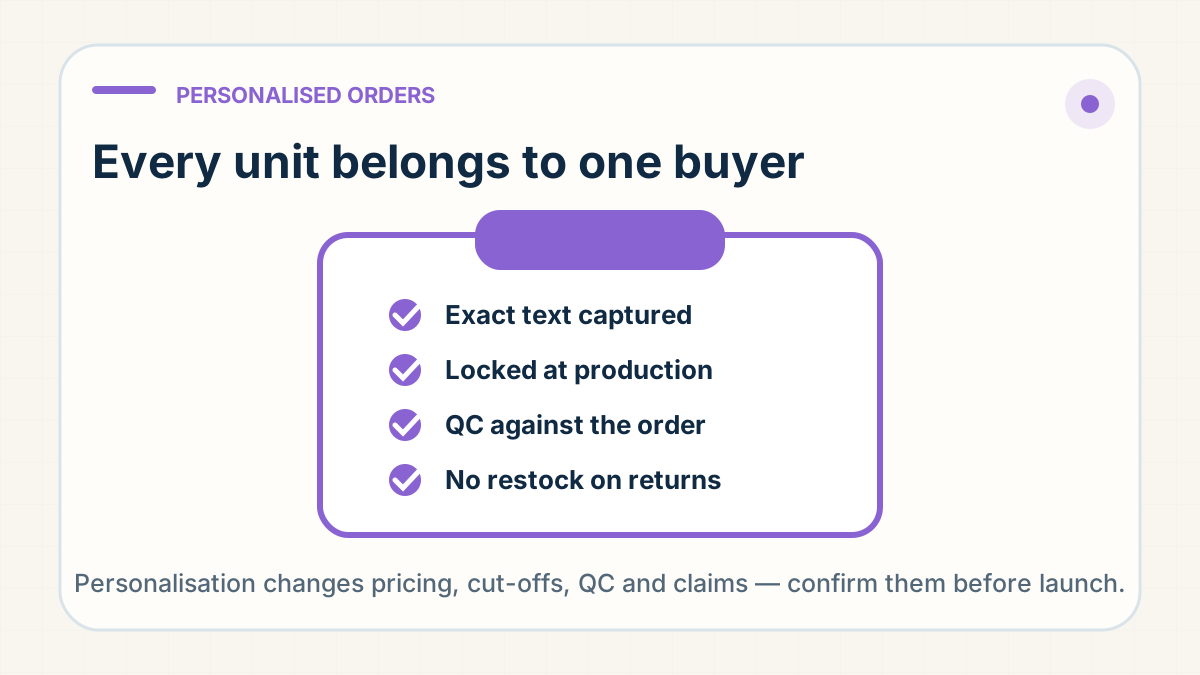
Personalised is not the same as branded
Branding changes every unit the same way: a logo sticker, a printed box, an insert card. Personalisation changes each unit for one buyer — an engraved name, embroidered initials, a printed photo, a chosen date. The two get discussed as if they were one topic, but they behave differently at every stage of fulfilment, and most of the painful surprises come from treating a personalised product like a branded one.
Where the custom text actually travels
A personalised order carries one extra piece of data the standard flow was never built for: the exact text, image or option the buyer chose. That value has to leave your storefront, survive the order sync or spreadsheet, and arrive at the factory exactly as typed. Before selling, confirm where the personalisation field lives in your store platform, how it reaches your fulfilment partner, and who checks it before production starts.
- Set a character limit and allowed characters at the storefront, not at the factory — an emoji or a script the machine cannot render should be rejected at checkout.
- Decide what happens with an empty or broken value before the first order arrives with one.
- Keep the buyer's raw input in the order record so a later dispute can be settled against evidence.
Give every digital asset an acceptance gate
Text is only one kind of personalisation input. A customer photo, artwork file or audio recording must also arrive in a form the production team can open and use. "Upload an image" or "send an MP3" is not a complete handoff. Get the production limits from the supplier, publish them at checkout, and run a dummy order through the full path before launch.
- Format and limits: name the accepted file types and the relevant size, resolution, dimensions, aspect-ratio, duration or page-count limits. Do not invent a limit at the storefront and hope the factory can use it.
- Access: require a direct upload or a downloadable link with working permissions and enough time before expiry. A file trapped behind the buyer's account is not production-ready.
- Identity and version: bind the asset to the order line and variant, keep the original submission, and make one approved revision unambiguous. A filename in a chat is not a reliable order match.
- Preflight and failure rule: check that the file opens, is not blank or corrupt, and meets the agreed limits before the production cut-off. Hold the order and request a replacement when it fails; do not guess or silently convert it.
- Proof where processing changes the result: if cropping, trimming, colour conversion or layout can change what the buyer receives, approve a preview before the irreversible step.
MOQs and unit cost work differently
Per-order text personalisation and batch logo customisation price differently, and a single supplier reply can contain both answers. In one sourcing example, a product family came back with per-order name customisation dispatching inside about two days, while a personalised logo on the same item sat behind a minimum of around fifty units. Embroidery tends to cost more per unit than printing, and engraving depends on the surface and the setup. None of those numbers transfer to your product — the point is to ask for the personalised price, minimum and dispatch time separately, because the listing price describes the plain unit.
The order-change window closes earlier
A standard order can often be changed or cancelled until it is packed. A personalised order effectively locks the moment production starts, because a mug engraved with someone else's name has no next buyer. Agree that cut-off explicitly with your fulfilment partner and mirror it in your store policy, so a buyer who wants to fix a typo an hour after checkout gets a clear answer instead of a negotiation.
QC has one extra job
Normal QC checks the product. Personalised QC also checks the personalisation against the order field: spelling, placement, and the font or colour where the buyer chose one. A photo of the finished personalisation before dispatch is cheap insurance — it settles most disputes before the parcel moves. The same check should confirm that craft products arrive complete: embroidery kits arriving without instructions led to recurring complaints.
Returns economics: there is no restock
A personalised unit that comes back cannot be resold, so every dispute ends in a remake or a refund, never a return to stock. Decide in advance which failures you remake at your cost — wrong text despite a correct order field, or damage in transit — and which you decline, such as a buyer typo you can prove against the order record. Publish that rule in your store policy; it is easier to point at a policy than to write one mid-argument.
Choosing the craft
- Engraving: durable, suits metal, wood and glass, needs a suitable surface and per-design setup.
- Embroidery: premium feel on textiles, higher per-unit cost, thread colours limit fine detail.
- Heat transfer and printing: cheapest and fastest for fabric and flat surfaces, less durable under wash and wear.
Whichever craft fits, sample the personalised version, not just the base product. The personalisation is the part your buyer is paying extra for, and it is the part a supplier photo is least likely to show honestly.
Approve the custom job before accepting it
Sell personalisation as a different product, not a variant. Confirm the data path and digital-asset acceptance rules, the personalised price and minimum, the real change cut-off, the QC evidence and the no-restock claims rule before the first order. Each of these is a five-minute question before launch and an expensive argument after it.
Planning branded packaging or a private-label run?
Share the product and the level of customisation you need on WhatsApp (wa.link/dropship). We will help you understand the practical next step.
Discuss Branding on WhatsApp →