The short answer
A 3PL executes logistics work such as receiving stock, storing it, picking and packing orders, arranging transport, returning tracking and handling returns. A 4PL sits above that execution layer and coordinates a broader network: warehouses, carriers, freight partners, systems and performance. A 5PL usually means technology-led optimisation across several supply chains. For most dropshippers, it is not a service category they need to buy.
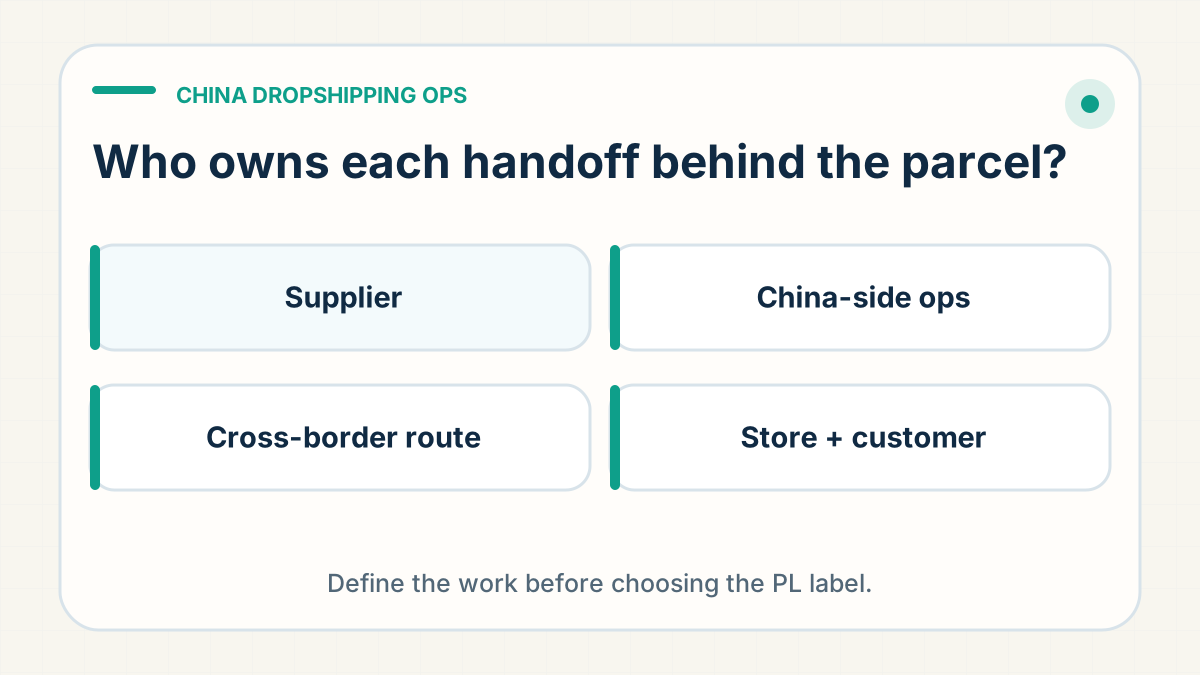
For a dropshipper shipping from China, the useful question is more concrete: who talks to the supplier, checks the product, holds any stock, chooses a route, pushes tracking back to the store and acts when the parcel or product fails? A China fulfilment agent may execute several 3PL tasks and coordinate several 4PL-shaped decisions without being a global 4PL. Write down the work before choosing the label.
The number is not a quality score. A dependable China-side 3PL or fulfilment agent can be the right answer for a growing store, while a provider calling itself 5PL may still leave the seller to resolve every real exception. The practical test is whether the order path has a named owner from supplier handoff to customer-visible tracking.
Map the China dropshipping chain first
A typical China dropshipping order can touch a supplier, a sourcing or fulfilment agent, a Guangzhou warehouse, a cross-border carrier, customs, a destination-country delivery partner, the selling platform and the seller's customer-support team. AliExpress hides some of those handoffs inside one marketplace order. Moving to a private agent exposes them, which creates more control but also more decisions to own.
- Supplier: makes or supplies the exact product version and packaging agreed.
- China-side agent or warehouse: receives or sources it, checks agreed attributes, packs the customer order and releases it.
- Cross-border route: accepts the product, destination and parcel profile, then produces tracking the store can use.
- Seller: owns the listing promise, retail price, customer communication, refund decision and any risk not delegated in writing.
If your current setup works only because you personally copy addresses, chase factories, compare tracking sites and tell two providers what the other one did, you do not merely have a shipping problem. You have an orchestration gap. That is the point at which the difference between 3PL execution and 4PL-style coordination becomes useful to a dropshipper.
3PL: warehouse and dispatch execution
Industry definitions of 3PL are broad. For a dropshipper, it is easiest to treat 3PL as the execution layer: receiving, storing, picking, packing, dispatch, tracking and returns. Extras such as sourcing, product checks, inserts or carrier selection belong in the scope only when they are agreed explicitly.
For a China dropshipper, a 3PL-type scope might begin after products arrive at a Guangzhou warehouse. The provider receives stock, records quantities, stores units, picks the correct variant, adds the agreed insert, packs the parcel, books the approved route and returns tracking. The seller may still be responsible for finding the supplier, approving quality, forecasting stock and checking whether the carrier works on the sales channel.
- Good fit: you already know the product and supplier, and need repeatable receiving, storage, packing and dispatch.
- Measure: receiving accuracy, inventory accuracy, same- or next-working-day processing where agreed, order accuracy, usable tracking and exception response.
- Do not assume: the warehouse will renegotiate your factory MOQ, validate every product claim or coordinate stock held by another provider.
If you are moving beyond marketplace fulfilment, first decide when a China dropshipping agent is actually useful and which supplier-facing work remains yours.
4PL: one owner across several providers
Industry definitions of 4PL vary. For a dropshipper, the useful meaning is one accountable coordinator across several suppliers, warehouses, carriers or systems. A warehouse does not become a 4PL merely because it offers several shipping lines.
For a dropshipper, 4PL-shaped work appears when one order depends on several parties behaving as one system. Examples include coordinating two Chinese suppliers into one bundle, preventing a China warehouse and a US 3PL from shipping the same line, changing the route when a marketplace rejects the carrier, or connecting a supplier defect to stock containment and customer remedies.
A useful coordination scope gives the seller one owner for a cross-provider problem. It may cover route options, stock-allocation rules, store handoffs, performance and exceptions. If the seller still has to chase every provider separately and assemble the answer, the coordination label is not doing useful work.
- Good fit: several suppliers, warehouses, carriers or sales channels now need one shared operating picture.
- Measure: end-to-end order outcome, allocation accuracy, exception ownership, next-update reliability and closure evidence.
- Do not assume: saying "we coordinate" means the provider has authority over your overseas 3PL, importer, returns node or platform settings.
5PL: usually not relevant to a dropshipper
5PL usually describes technology-led optimisation across several supply chains, and even the industry definition is still unsettled. Importing Shopify orders, choosing among several shipping lines or using an order-management tool does not make a China agent a 5PL. Those are useful fulfilment and coordination functions, not proof of a new service tier.
Unless you operate several brands, warehouses and carrier contracts at substantial scale, ignore the 5PL label. Ask who controls the SKU, checks route eligibility, returns usable tracking and owns the exception. Only evaluate a 5PL claim when the provider can show which network-wide decision its technology changes and which measured outcome improved.
Which model fits your dropshipping stage?
- Testing one product through AliExpress: you may not need a separate logistics provider yet. Prove demand, but record delivery, packaging, variant and support failures that the marketplace setup hides.
- Moving a winner to a private China agent: you usually need sourcing or supplier receipt, agreed QC, customer-ready packing, cross-border dispatch and store-compatible tracking. This is commonly a mixed agent and 3PL-type scope.
- Holding stock for faster processing: you need inventory ownership, reorder points, version control and a rule for slow stock, not merely cheaper unit pricing.
- Using China plus a US, UK or EU warehouse: you need 4PL-shaped allocation and reconciliation controls even if each warehouse is a capable 3PL.
- Operating several brands, warehouses and carrier contracts at substantial scale: only then might a formal network-optimisation layer be worth evaluating.
For the stock decision, compare dropshipping, Guangzhou pre-stock and an overseas warehouse using the product's real demand and delivery promise rather than treating warehouse location as a maturity badge.
China dropshipping case 1: the parcel moved, but the marketplace rejected the tracking
In one reviewed case, a China carrier could physically move an oversized order, but the marketplace did not accept the returned tracking format. Explaining that the parcel remained trackable did not answer the dropshipper's actual problem: the selling channel needed to recognise the carrier before its dispatch deadline.
Providing a tracking number is normal fulfilment execution. Maintaining a platform-by-country carrier-compatibility matrix, running a test order, stopping release when the marketplace rejects the service and approving an alternative across the seller and logistics provider are coordination controls. That is the kind of problem that reveals a 4PL-shaped need even when only one parcel is involved.
Before the first live order, use a platform fulfilment preflight to test order receipt, address visibility, carrier acceptance, tracking return and the customer-facing status together.
China dropshipping case 2: one Shopify order, three warehouses
Another reviewed seller held inventory in China, the US and the UK. Shopify could split one order by location: one item might be fulfilled from returned US stock while another shipped from China. The unresolved danger was whether the China-side order system could see that the US warehouse had already fulfilled its line. If it could not, both locations might ship the same item.
Each warehouse can execute its own pick and pack correctly while the total order still fails. The missing layer is shared allocation state, node-level inventory visibility, split-fulfilment rules and one owner for reconciliation. Adding another 3PL does not solve that problem automatically; it increases the need for orchestration.
China dropshipping case 3: another refund is not supplier control
A recurring electronics case produced individual replacements and refunds for similar failures across several orders. Those remedies helped the affected customers, but the repeated pattern raised a different question: who calculates the defect rate by model and batch, contains suspect stock, asks the supplier for root cause and decides when shipping should stop?
For a China dropshipper, replacement handling is only the customer remedy. Supplier corrective action crosses the China factory, receiving, QC, stock status, customer support and commercial approval. It needs one defect register and one decision owner across those functions; otherwise the agent can keep replacing units while the supplier keeps sending the same failure.
When similar failures repeat, move from case remedies to the supplier corrective-action process without delaying fair refunds or replacements for current customers.
China dropshipping case 4: the job began before warehousing
Several reviewed sellers were not handing over finished, forecastable stock. They needed a factory minimum negotiated, a sample or material checked, stock sent to Guangzhou, packaging decided, the packed parcel measured, air and sea options compared, and then individual orders fulfilled. Other briefs added batteries, dangerous-goods restrictions, certification evidence, DDP questions or destinations with limited routes.
A conventional destination-market 3PL is built to receive and fulfil inventory that the seller has already chosen and imported. A China fulfilment agent may operate earlier: supplier coordination, sourcing, QC, packaging and cross-border route preparation, followed by warehouse fulfilment. Some of that is 3PL execution and some resembles 4PL coordination. The label matters less than writing down exactly which decisions the agent owns.
Give the agent something operational to work from: a product sourcing brief suppliers can actually quote with the exact version, material, dimensions, packaging, destination and evidence required.
China dropshipping case 5: automatic orders still need owners
Shopify and WooCommerce can support connected order and tracking flows. Other marketplaces or configurations may require manual steps, expose limited address data or accept only certain tracking arrangements. In the reviewed cases, sellers sometimes interpreted automatic fulfilment as a promise that invoicing, purchasing, route eligibility and every exception would also happen without intervention.
For a China dropshipper, automation moves defined order data through a defined path. It does not decide whether a remote address is serviceable, a product document matches the exact SKU, a supplier sent the wrong colour, the parcel is too large for the planned route or the carrier is acceptable to the marketplace. Those decisions still need explicit owners, evidence and cut-offs.
Treat the connection as one control, not the whole service. This guide to what a store integration does and does not solve separates automatic data movement from human fulfilment decisions.
Where a China fulfilment agent fits
A China fulfilment agent is not automatically a 4PL, and it is not simply identical to a local stock-holding 3PL. Its useful scope can combine supplier-facing and warehouse-facing work: source or receive products, coordinate factories, inspect agreed attributes, store stock, prepare customer-ready packs and dispatch internationally.
RyanFulfil performs 3PL-type execution and selected China-side coordination across suppliers, warehouse work, routes, store connections and exceptions. That can solve 4PL-like problems within the agreed China-to-customer scope. It does not mean RyanFulfil should claim to manage every overseas warehouse, carrier, importer, return node or technology layer in a seller's global network. Those responsibilities have to be agreed and tested, not inferred from a label.
What to ask a China agent before moving a winning product
- Supplier handoff: will you source the item, buy from my supplier or only receive finished stock?
- Product control: which exact attributes will be checked, at what frequency, and what happens when they fail?
- Stock: who owns the goods after I pay a deposit, and how will I see available, reserved, damaged and inbound quantities?
- Packing: which variant, insert, label and parcel specification is the approved version?
- Route: who verifies product eligibility, destination coverage, customs data, billable weight and marketplace tracking compatibility?
- Store flow: which platforms exchange orders and tracking automatically, and which still need a seller action?
- Exceptions: who owns a wrong item, supplier delay, no-scan parcel, address problem, failed delivery, defect cluster or stock mismatch?
Do not accept "fully automatic" or "we handle everything" as the answer. Ask for the input, decision owner, handoff, evidence and next-update time for each stage. That is more useful than asking whether the agent is a 3PL, 4PL or 5PL.
A hybrid can be more sensible than choosing one label
A seller can keep test products and long-tail SKUs in China while moving a proven, forecastable winner to a destination-market 3PL for faster domestic delivery. Returns stock may be held separately. Different countries may justify different nodes. The important work is deciding which SKU and customer promise belongs in each flow, then preventing the systems from allocating or shipping the same line twice.
Compare your actual weekly work and provider quotes with the self-fulfilment vs 3PL vs agent calculator. It deliberately keeps operating fit separate from cost and does not invent a universal order-volume threshold.
A 30-minute audit for your current dropshipping setup
- Take the last ten delivered orders and mark every manual message, copy-and-paste step and provider chase.
- Take the last five exceptions and record who noticed each one, who could decide, and how long the customer waited for a useful update.
- Check whether the product version, supplier, packaging, packed weight and approved route are recorded together for each active SKU.
- Check whether tracking works inside the selling platform, not merely on a separate tracking website.
- Check whether paid, inbound, available, reserved, quarantined and overseas stock can be reconciled without asking several people.
If the failures sit inside receiving, packing or dispatch, strengthen the 3PL execution scope. If they sit between suppliers, warehouses, carriers, stores and support, add an accountable coordination layer.
Choose by ownership, not by the acronym
For China dropshipping, choose the smallest operating model that gives every important decision an owner. Use a 3PL-type scope when the product and process are defined and you need dependable warehousing and dispatch. Add 4PL-style coordination when suppliers, China stock, overseas stock, platforms, carriers and exceptions have become a separate operational job.
A higher number does not make a dropshipped parcel safer. An exact product brief, agreed QC, visible stock, a route that accepts the product, tracking the store recognises and a person who owns the exception do.
What this guide can and cannot show
The definitions on this page follow CSCMP's working distinction between 3PL execution and broader 4PL orchestration, Accenture's account of the evolving 4PL market, DHL's practitioner description of 5PL and peer-reviewed research that says 5PL remains early and not well defined. The China dropshipping examples pool anonymised RyanFulfil client situations; names, stores, addresses, order references and identifying combinations are excluded. They illustrate responsibility gaps, not a claim that every 3PL, 4PL, 5PL or fulfilment agent works in the same way.
The rule: For China dropshipping, choose the smallest scope that gives every critical decision an owner. Use a 3PL-type scope for defined warehouse and dispatch execution, add a lead 4PL-style layer when suppliers, stock locations, carriers and stores need one accountable coordinator, and treat any 5PL claim as something to verify through network data, decisions and measured outcomes rather than a higher-number badge.
Have a specific fulfilment question?
Send us the product, destination and order context on WhatsApp (+86 178 4666 9989), and we'll answer for that order instead of giving a generic estimate.
Ask Questions on WhatsApp →