Field note
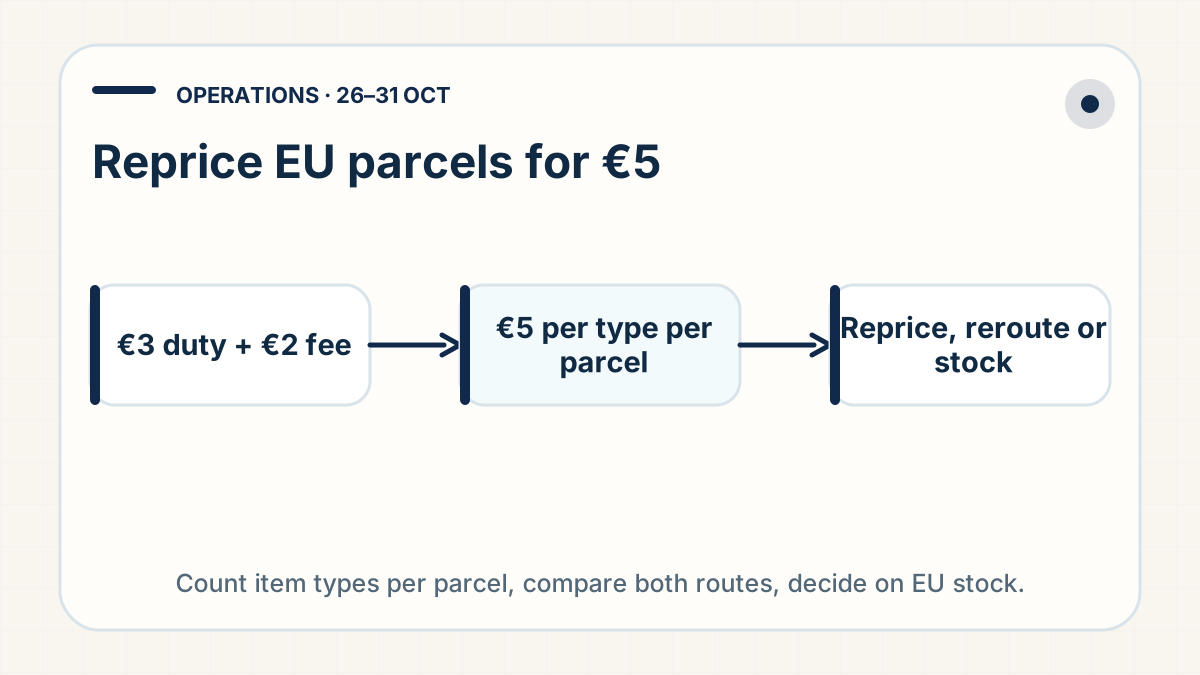
Reprice every EU product before your next order clears customs. From 1 November 2026, the EU line on our quotes rises from €3 to €5. The €3 temporary customs duty stays, and the new €2 EU handling fee sits on top of it.
Between 26 and 31 October, more than twenty sellers asked us how the new charge works. Their questions came down to four things: what the €5 counts, whether the quote includes it, which route to use and whether EU stock avoids it.
What exactly changed on 1 November?
The EU is adding a €2 handling fee. The European Commission's customs guidance of 5 October 2026 expects it to apply from 1 November. The EU quote guide explains our quote basis.
Parcels spend several days in transit before they reach EU customs. Our logistics providers therefore began collecting the fee on EU parcels dispatched in the last week of October. We do not top up paid orders. If an earlier quote carried the €3-only line, add €2 to it for your next order.
Is the €5 per parcel or per product?
Our EU €5 quote line applies per parcel, once for each type of item: €3 temporary duty plus €2 handling fee. Ten of the same item in one parcel pay once. For similar items, such as different colours or sizes, check with us and we will confirm.
Ask for the item count on your typical basket, not only on a single unit. Then recheck your bundles and free gifts, because an add-on that is another type of item in that parcel now carries €5 instead of €3. Check similar items with us first. The bundle and free-gift cost checklist walks through that margin test.
Does the handling fee stop at €150?
No. The €3 duty applies only to low-value parcels worth up to €150. The €2 handling fee has no value ceiling, and it has no end date either. A higher-priced product therefore still carries the €2 handling fee when shipped straight to an EU customer.
Is the €5 inside my quote or added later?
We show it on the quote before you pay, as its own line. Your customer normally pays nothing at the door, because we ship DDP unless you ask for DDU: duties and import VAT travel inside the shipping route. The DDP and DDU guide explains what that means for your customer.
Once you pay an invoice, its prices stay final. We announce price changes before they apply to future quotes, as we did with this one. A notice in late October therefore changes your next quote, not an order you already paid.
Where can I read the rule myself?
Several sellers asked us for the official source before they repriced. Read the European Commission's customs guidance on the €3 duty and the handling fee; our FAQ answer on the EU charges names it and sums up both parts. Give your accountant that guidance, not a forwarded notice, when you check your own VAT position.
Which route should EU parcels take now?
Ask for two delivered totals on your top EU product. On one of our main EU lanes, the standard route quotes 6–9 business days and carries the €5 line. The tax-inclusive route quotes 9–15 business days and clears through a different model. Its price changed on 26 October, so an older figure no longer holds.
Choose by your customer's patience as much as by the cost. One seller kept the faster route ahead of a bigger ad budget, because slow parcels drive refund requests and payment holds. The provider expects the tax-inclusive saving mainly on light parcels, so compare the totals rather than assume. Peak season can add a few days to either route.
Does stock in an EU warehouse avoid the €5?
Yes, for the customer parcel, if the goods cleared customs in bulk and entered free circulation before the sale. An order shipped from that stock is a domestic delivery, not a low-value import. Stock in a customs warehouse, or goods sold before storage, can still pay the €5. Your bulk shipment still pays normal import costs, and storage, inbound freight and domestic postage replace the €5. Dropship, pre-stock or overseas warehouse? compares those costs on one product.
Stock the country where most of your customers live. Shipping from a German partner warehouse to French customers costs more than shipping inside France. Our partner route into EU warehouses quoted about five weeks in transit this week, so Christmas stock has to leave China in early November.
What to carry into next week
Build a one-page EU price sheet for your top three products. For each one, write down the customs items in a typical basket, the standard and tax-inclusive delivered totals, and your new margin at the current retail price.
Then make one dated decision per product: reprice, switch route or send stock. If you choose stock, ask us this week for the shipping cut-off that lands it before your Christmas peak. The landed-price quote guide shows how to compare the old and new quotes on the same basis.