The point where dropshipping stops being the right word
There is a recognisable moment in a growing brand's life when the questions change. Instead of asking what a product costs and how fast it ships, a seller starts asking who makes it, whether the design can be protected, who owns the tooling, and what happens if quality drifts. Those are contract-manufacturing questions, and they deserve contract-manufacturing answers rather than reassurance.
The frustrating part for sellers is that the answer is genuinely mixed. Some of what they ask for is standard and easy to arrange. Some is expensive but available. And some cannot be provided at all by an agent, for reasons that are commercial rather than evasive. Knowing which bucket each request falls into saves weeks.
Usually yes: things a serious agent should arrange
- A written manufacturing agreement with the producing factory covering specification, quantity, lead time and acceptance.
- A defined acceptable quality limit and an inspection standard applied before shipment, rather than an informal spot check.
- Pre-production and golden samples, retained as the physical reference every later batch is judged against.
- Third-party laboratory testing at an accredited lab, quoted as its own line item.
- Recorded video of the production line or the packing process, supplied by the factory.
- Written confirmation of material, composition, dimensions and any regulated component.
- Notification and re-approval when the producing factory changes — this one matters more than sellers expect.
Usually possible, but priced and slow
Custom production in a material the trade does not normally use for that product is the classic example. A shape that is standard in one material can be a bespoke run in another, which converts a sourcing request into a tooling and minimum-order conversation with a lead time measured in weeks. Certification is similar: obtaining a test report for a specific model at an accredited laboratory is achievable and carries a real four-figure cost, which somebody has to agree to pay before anyone begins.
The mistake here is treating the cost as an obstacle rather than as the actual price of the thing being asked for. A seller who wants documented compliance for their exact product is asking for laboratory work, and laboratory work has a price list.
Usually no, and here is why
Full factory identity — legal name, address and business licence — is normally withheld, and sellers often read that as the agent protecting a margin. That is part of it, and it is not the whole of it. A sourcing relationship is built on supplier access that took years to develop; handing it over converts the agent into an introduction service that will be bypassed on the next order. Most agents will name the factory only under a commercial arrangement that accounts for that, and the honest ones say so rather than inventing a compliance reason.
Unannounced live video from a production floor is also normally unavailable, for the plain reason that the agent is not standing in the factory. Recorded footage supplied by the factory is a reasonable substitute; a live, unedited walkthrough on demand generally is not, and an agent who promises one should be asked how.
A non-disclosure and non-circumvention agreement with a factory is worth understanding before relying on it. Factories will frequently sign one for a genuinely custom design they are producing to your drawings. They are far less willing to sign restrictive terms over a stock item already in their catalogue and already sold to other buyers, and a signature on that item would not mean much anyway.
Mould ownership is the question sellers most often forget
If your product needs new tooling, decide in writing who owns it before it is cut. The three normal positions are that the factory owns it, that you own it and it is held at the factory, or that you own it and can move it. Each has a different price, and the difference only becomes visible on the day you want to change supplier.
Ask three things explicitly: who owns the mould, whether the factory may use it for other customers, and what happens to it if you stop ordering. A mould you paid for but cannot move is not really yours, and the time to discover that is not during a supplier dispute.
How to ask so the answers are comparable
- Send the same brief to every option, with the same non-negotiables and the same destination market.
- Ask separately for the sample cost, the small-run cost and the unit cost at minimum order quantity — they answer different questions.
- State which certifications you need and for which market, and ask who pays for testing.
- Ask what happens on a failed inspection: rework, replacement, discount or rejection, and who bears the cost.
- Ask what triggers re-approval — a material change, a factory change, a component change or a tooling repair.
Separate factory access from factory control
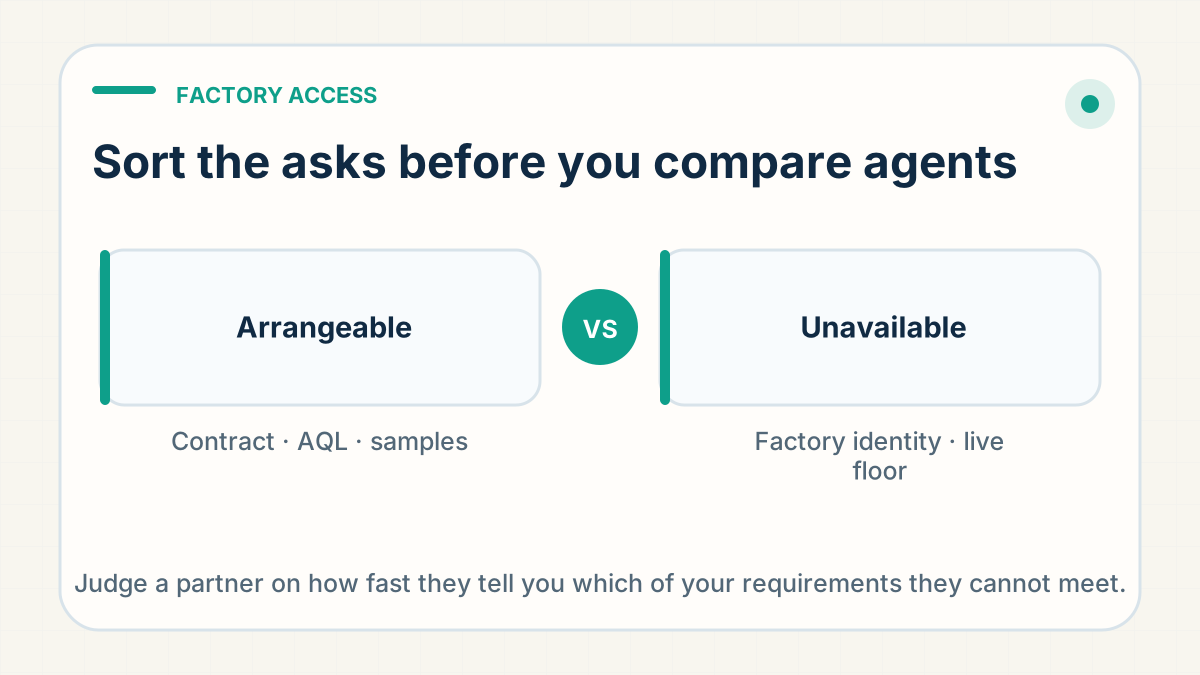
Sort your requirements into arrangeable, purchasable and unavailable before you start comparing partners, and judge an agent on how quickly they will tell you which is which. An agent who says yes to everything is not a better partner than one who explains that factory identity stays confidential, that laboratory testing has a price, and that a mould needs an owner named in writing.
The rule: Ask the agent to state what was verified, when and against which product version. Factory identity, capacity, exclusivity, lead time and compliance require different evidence; where the evidence is absent, preserve the uncertainty instead of turning a useful sourcing contact into an unsupported guarantee.
Need a product checked before you spend on ads?
Send us the product link and destination on WhatsApp (+86 178 4666 9989). We'll check sourcing, packing and shipping with you before you commit.
Get Sourcing Quote on WhatsApp →