Field note
The situation
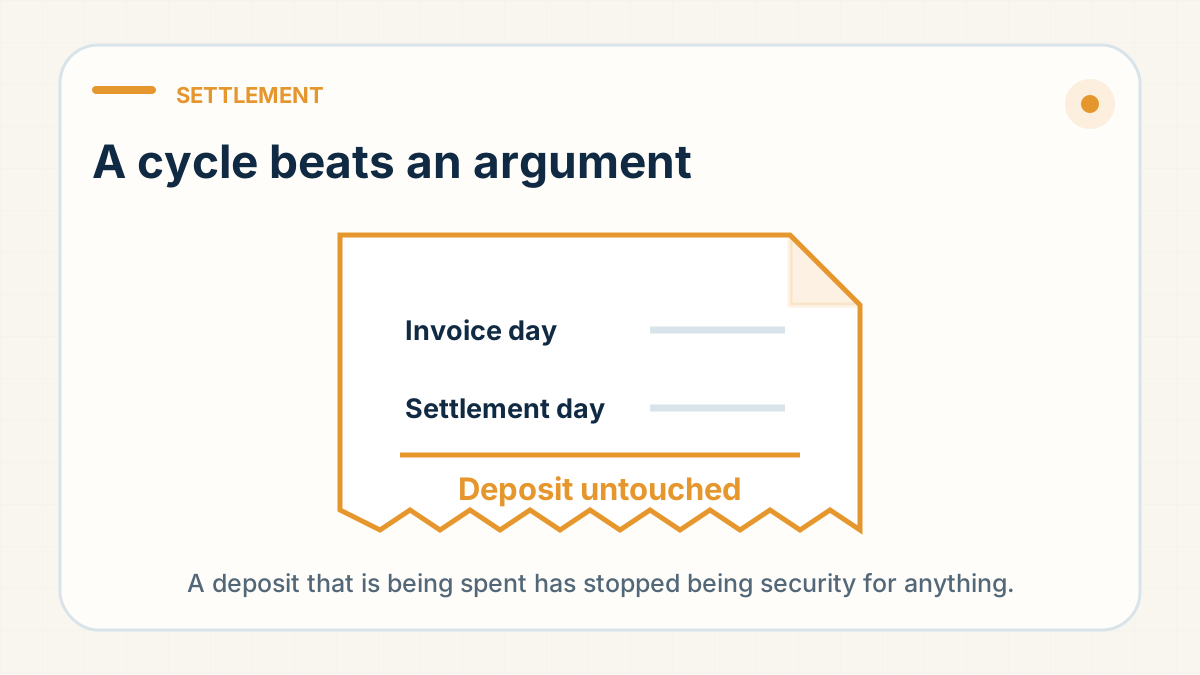
If payment holds cost you delivery time, ask for a settlement rhythm: a named invoice day and a named payment day. A long-standing seller raised something that had clearly been building. They wanted orders fulfilled as they arrived rather than held until each invoice cleared, arguing that years of prompt payment and a standing deposit ought to buy that trust, and that shipping delays caused by the wait were generating chargebacks and customer enquiries on their side. It was a fair account of a real cost. It was also asking for a change to a financial control rather than to an operational one.
- 01Fix the invoice dayPredictable paperwork the seller can plan a payment run around.
- 02Fix the settlement dayPurchasing continues through the week against the agreed cycle.
- 03Keep the deposit untouchedA deposit being spent has stopped being security for anything.
- 04Agree the fallbackWhat happens if a cycle is missed, decided before it is missed.
Two reasonable positions, one missing mechanism
Both sides were right about their own risk. Fulfilment cannot be funded from a security deposit, because a deposit that is being spent is no longer security for anything — its whole function is to sit still. Equally, an operation that pauses dispatch every time an invoice is open converts a payment-timing question into a delivery-performance problem the seller has to explain to their customers. The gap was not goodwill. It was that no one had agreed a rhythm.
What was actually agreed
The resolution was a fixed weekly settlement: invoices issued on a set day, settled on a set day, and purchasing continued through the week against the agreed cycle rather than order by order. The deposit stays where it is and keeps doing its job. Two conditions made it workable — advance notice if a settlement will be late, and a stated fallback to the previous pay-first workflow if the cycle stops being honoured. A concession without a fallback is not a policy, it is a hope.
Invoices should follow the seller's calendar
A quieter version of the same theme appeared elsewhere. One seller asked for invoices split to match their own store days rather than our export batches, because a single invoice spanning two of their trading days made reconciliation slow at their end. The underlying request in both cases is the same: predictable financial artefacts that fit the seller's operating cycle, so payment becomes routine instead of a negotiation.
There is a real constraint behind that one, and it is worth naming because it recurs: a time-zone gap means a batch exported at the start of one working day in China can contain orders from two different trading days in Europe. The order export does not carry the seller's local placement time, so the split has to be requested rather than inferred. The workable arrangement is for the seller to say in advance which order numbers belong to which of their days, once, instead of correcting each invoice after it is issued.
An accumulating balance becomes its own dispute
A different account showed the opposite failure. Payments had not been made for several weeks, the balance had grown across many orders, and the seller had reached the point of questioning whether the total was even accurate. That is the predictable end state of an open-ended balance: once a bill is large enough that nobody can reconstruct it from memory, both sides start defending positions instead of settling.
The advice given was blunt and correct — settle weekly rather than letting a balance run, precisely so that the amount stays small enough to check. A seller under cash pressure often wants the opposite, and the sympathetic instinct is to let it ride. It is not a kindness. A large unexplained balance costs the relationship more than an awkward conversation at a quarter of the size, and it arrives at exactly the moment the seller has least room to absorb it.
Cash-flow honesty runs both ways
Several sellers were candid about being short of working capital, and one said plainly that an unexpected invoice would stop them placing the next order. That is useful information rather than a complaint, and the operational response is not to waive the amount but to change its shape: charge for stock as it is consumed rather than as a lump sum, split a settlement across instalments with a stated end date, or hold a purchase until funds are confirmed with the delay made explicit.
What does not work is silence in either direction. A seller who goes quiet about a payment and a partner who goes quiet about a delay produce the same outcome, which is a customer waiting for a parcel that nobody has started buying.
New seller desk
Alongside the settlement work, the newer conversations were about products rather than terms — broad accessories, apparel and home goods across European markets and the US, mostly at the enquiry and quotation stage. Payment terms rarely matter at that point. They begin to matter at the exact moment a seller has enough repeat volume for a stop-start funding cycle to become visible to their customers.
Replace the standoff with a settlement rhythm
If holding orders for payment is costing you delivery time, ask for a settlement rhythm rather than an exception. A named invoice day, a named payment day, an untouched deposit and a stated fallback solve more than an argument about trust.