Field note
The situation
Get the order-change cut-off in writing before a customer asks for a change: the hour, the day and what each stage still allows. Wednesday was full of changes: address corrections, variant swaps, added and removed items, holds and outright cancellations. Some were easy. Some were impossible. The difference had almost nothing to do with how reasonable the request was and almost everything to do with where the parcel already was.
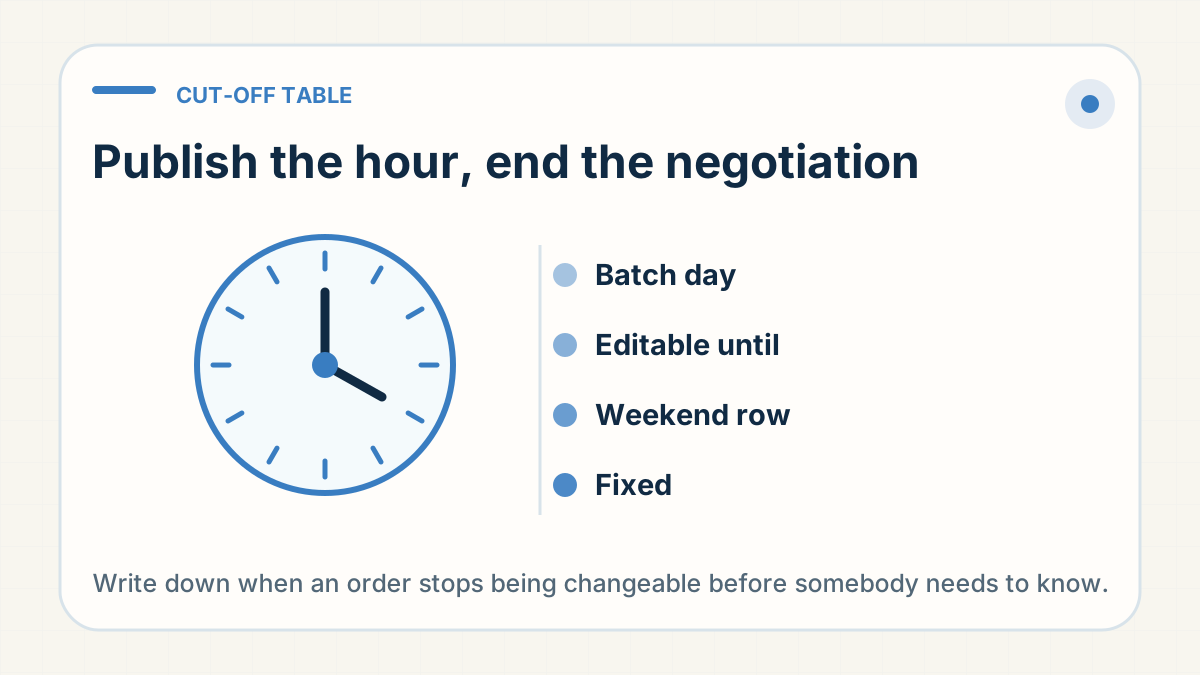
- 01Map batch day to ship dayWhich day’s orders are processed on which day.
- 02Set the editable-until hourOne time, in a stated timezone, that both sides can quote.
- 03Write the weekend rowA rule assuming seven-day operation is wrong every week.
- 04Say what survives the cut-offUsually an address correction; usually not a product change.
The most useful thing agreed this week was a table
One warehouse-side workflow with a same-day dispatch cut-off had been producing repeated friction, because a request that arrived at a perfectly normal hour for the seller could arrive after the point of no return for us. Rather than handle each case as a favour, both sides wrote down a matrix: which day's orders are fulfilled on which day, and the exact hour after which that day's batch stops being editable. Weekend orders got their own row, because a rule that pretends factories and warehouses work on Sunday will be wrong every week.
That document is unglamorous and it removed an entire class of argument. The seller now knows when to chase their customer for a corrected address, and the warehouse is no longer choosing between a broken cut-off and an unhappy client.
What each stage still allows
Before purchase, almost anything can change. After purchase but before packing, the product is fixed but the destination usually is not. After packing, an address change means unpacking and repacking, and a variant change means starting again. After carrier handover, the honest answer is usually that the order cannot be recalled, and that the remaining options are refusal, return, redelivery at a cost, or letting it land and handling it as an after-sales case.
Cancellations have a cost even when they are granted
A seller whose marketplace account was suspended mid-week asked us to stop everything. Orders not yet bought were simply cancelled. Orders already purchased from suppliers could still be refunded, but with a domestic handling deduction, because the supplier had already moved goods. Saying that plainly at the moment of cancellation is better than a clean-sounding promise followed by an unexplained shortfall on the next statement.
The same seller had a second decision to make on the orders that were already in our warehouse and ready to go. Those were genuinely still shippable, and the right question was commercial rather than logistical: with the storefront suspended, was there any value in the parcel arriving? For some items there was, because the end customer had paid and would otherwise chargeback. For others there was not. Splitting the queue that way took a few minutes and saved a full refund cycle on the orders that could still land.
A held order is not a cancelled order
A recurring source of confusion is the difference between "do not ship this yet" and "do not ship this at all". Holds are cheap and reversible; cancellations release stock, may trigger a supplier deduction and cannot be un-done at the same price. Several requests on Wednesday arrived phrased as one and meant the other.
The fix is small: confirm back which of the two has been actioned, and for a hold, say what will release it and when it expires. An order held indefinitely with nobody watching it becomes a customer waiting silently, which is worse than either outcome the seller was choosing between.
Refunds where the goods will never move
Wednesday also contained the least satisfying category of change: orders that could not proceed for reasons outside anyone's control. A dress out of stock at the factory until after the customer's event date. A destination with no serviceable route. A returned parcel the overseas warehouse will dispose of if nobody claims it. In each case the merciful answer is an early refund rather than an optimistic hold.
The signal to watch is a fixed external date — a wedding, a birthday, a trip. Once the operational timeline cannot beat that date, holding the order only converts a clean refund into a late refund plus a disappointed customer. Recommending the refund is better service than protecting the order value.
New seller desk
The newer conversations were weighted toward beauty and personal care, accessories and home goods, with European destinations dominating and the US close behind. Their scale ran from first tests to low tens of orders. That is precisely the range where an explicit cut-off is worth agreeing early: small enough that nothing has gone wrong yet, large enough that it will.
Change the order while it is still changeable
Ask your fulfilment partner for the cut-off in writing before you need it — the hour, the day, and what each stage still allows. A change window you can quote to your own customer is worth more than an exception you have to request.