From the operations archive
The cheaper lane could not carry the same promise
A seller comparing routes across several destinations wanted one default that could simplify checkout and fulfilment. WANB was attractive on some lanes, especially for ordinary compact goods. But a remote postcode, a different packed size and the seller’s preferred delivery promise changed the comparison. A service that fitted the main market did not automatically fit the exception.
The lowest visible rate answered only one part of the decision. Operations also needed to know whether the item was accepted, where chargeable weight landed, when a meaningful scan appeared, which local partner completed delivery and what the trace process looked like. Saving on the label could be poor value if support later had no workable milestone or the postcode needed another service.
The team used WANB where the named line matched the item, lane and promise, and recorded another route for the cases it did not. That is not inconsistency; it is controlled routing. WANB makes sense as a specific service choice with known boundaries. It does not make sense as a universal policy created from one favourable quote or one successful parcel.
About this story: it is an anonymised composite of client situations. It broadens markets and product families and leaves out identifying details. Read the dated field note: The value of a clear route check.
We use a mix of carriers, not one default option, because no single carrier is the right answer for every product and destination. WANB Express is a real, legitimate option we consider for certain shipments. Here's honestly where it tends to fit and where we'd reach for something else.
Where WANB tends to be a strong fit
1. UK-bound shipments where verified bonded-warehouse infrastructure supports faster, more predictable customs clearance. 2. Apparel and bulky-but-light products, where a dedicated line skipping volumetric weight can genuinely lower cost. 3. Products needing sensitive-goods handling within its supported categories, batteries and liquids within its stated limits. 4. Routes and destinations where its specific line options are competitive on both cost and actual delivery experience.
Where we'd generally look elsewhere
1. Extremely time-sensitive shipments where the fastest possible premium express option matters more than cost. 2. High-value or fragile goods where compensation limits on loss or damage don't adequately cover the product's worth. 3. Destinations outside its stronger coverage areas, where another carrier has a better track record. 4. Products that fall outside its supported sensitive-goods categories entirely.
Why we don't default to one carrier
Carrier performance isn't fixed. A route that's fast and reliable this season can get congested the next. A carrier that's strong for one product category can be a poor fit for a different one shipped to the same country. Defaulting to a single carrier for every order means inheriting its weak points along with its strong ones, on every single shipment, regardless of whether it's actually the right tool for that specific job.
What we actually check before assigning a route
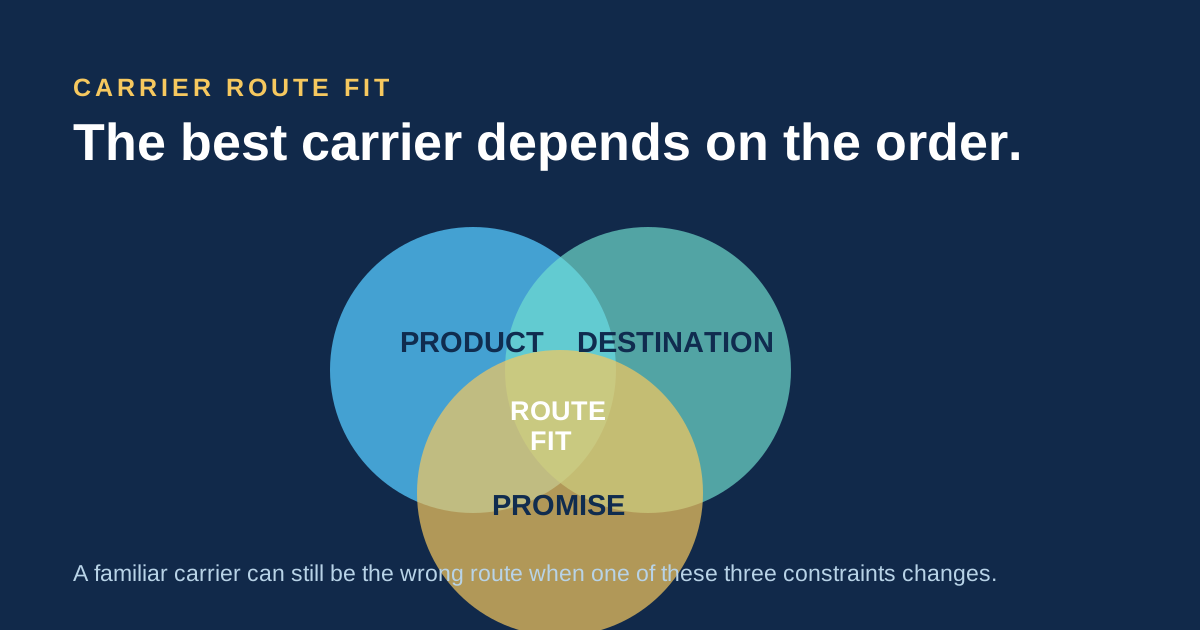
1. The product's category and any special handling or documentation it needs. 2. The destination and how that carrier's specific lines perform there currently, not just on paper. 3. What delivery promise you've made to your customer, and whether the route can genuinely support it. 4. Cost, including compensation terms if something goes wrong, not just the headline shipping rate.
What this means for you
You shouldn't need to know or care whether a specific order ships through WANB, another mainstream carrier, or a specialty line, that's the comparison we're supposed to be doing on your behalf. We look at the actual product, destination, and promise, and route it to whatever genuinely fits best, not whichever carrier happens to be cheapest or most familiar that week.
Judge the named WANB service against the exact parcel and lane. Confirm eligibility, packed cost, tracking milestones, delivery range and exception support, then run a small controlled test before moving normal volume.
The rule: Use WANB where a named line fits the parcel and the seller's measurable priorities; reject it where coverage, tracking, delivery range or exception support conflicts with the promise. The decision can differ by SKU and country without either conclusion becoming a verdict on the whole carrier.
Waiting for a parcel you bought? Contact the store you ordered from: it holds your order details.
Need one order or route checked?
Worried about an order's tracking? Send us the order number on WhatsApp (wa.link/dropship) and we'll check what's going on.
Check Order on WhatsApp →