From the operations archive
The tracking page showed why the service name mattered
A busy dispatch queue contained compact consumer goods whose models changed frequently. A parcel could be packed correctly while its record still carried an older variant name or a late address amendment. Once released, the shipment would pass through export acceptance, international movement and a destination handoff—stages that the customer might see under different tracking names.
Ask for the exact WANB service line and expected tracking handoff for your order. Compare speed, cost, destination coverage, product acceptance and the local delivery partner. The carrier name alone does not show whether a tracking event is an expected handoff or an exception that needs investigation.
Before release, the team aligned the product version, address, named route and customer promise. The specific service line then became an operational record, not marketing vocabulary. It explained when the first useful scan should appear, which handoff came next and when to investigate. That is the practical reason to understand the lines: they define different journeys even when the same carrier group sits at the top of the page.
About this story: it is an anonymised composite of client situations. It broadens markets and product families and leaves out identifying details. Read the dated field note: When dispatch and tracking need the same plan.
Ask about "WANB shipping" and you'll run into the same problem as with most Chinese cross-border carriers: it's not one product, it's a family of different lines with different speeds, price points, and rules. Picking the wrong one for a given product or promise is a common, avoidable mistake.
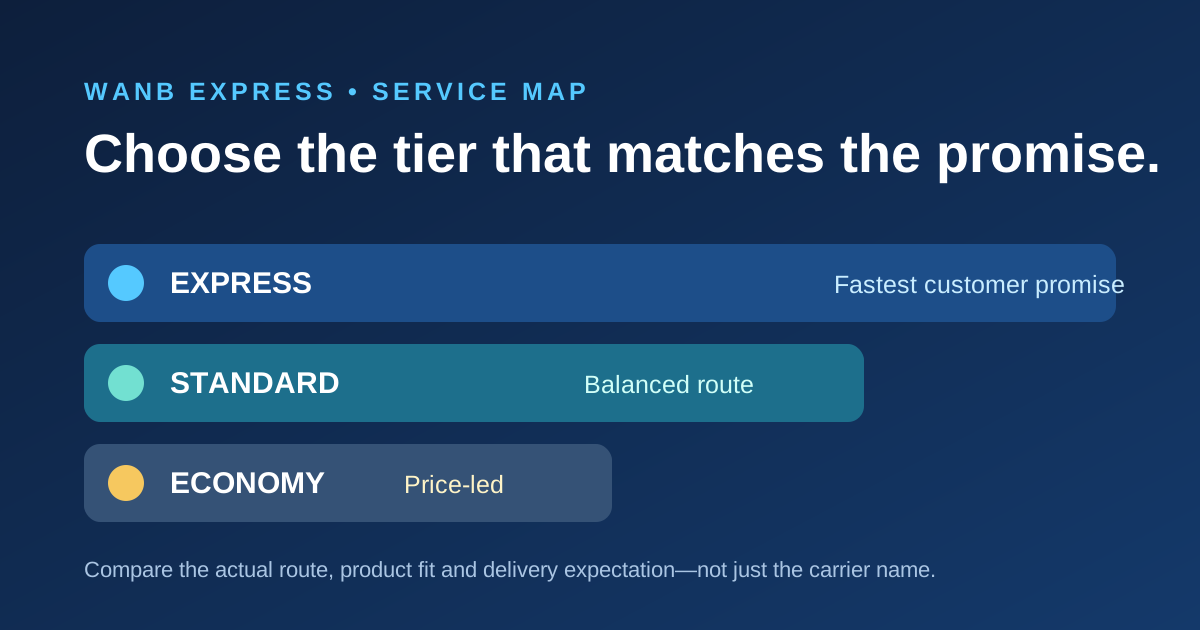
The fast line
Their fastest tier is built for speed over price, typically landing in the single-digit-day range to core markets like the UK and Germany, with relatively quick clearance built in. This is the line to use when a customer promise depends on genuine speed, and you're willing to pay more per parcel to hit it.
The standard special line
A middle tier covering a much broader set of destinations, usually a bit slower than the fast line but still tracked and reasonably predictable, with sub-variants for different product types, general goods, battery-containing items, and increasingly, specific categories like cosmetics or apparel. This is usually the default choice for a normal dropshipping order that doesn't have an unusual urgency requirement.
The economy small-parcel line
The cheapest, slowest option, often running into the two-to-three-week range or longer, and typically less trackable in detail than the faster lines. This is the line low-margin, price-sensitive listings tend to default to, and it's also the line where "tracking looks stuck" complaints cluster hardest, simply because the visibility is thinner by design at this price point.
Why the sub-variants matter as much as the main tier
Within these broad tiers, specific product categories, batteries, liquids, cosmetics, apparel, sometimes get their own dedicated sub-line with different size, weight, and documentation rules. Shipping a battery-powered product through a line that isn't built for it, or assuming a generic line automatically covers a sensitive category, is how shipments get held up or rejected mid-transit.
How we actually decide
We don't default every order to the cheapest available line. We look at what's actually being shipped, what documentation or handling it needs, what destination it's going to, and what delivery promise you've made to your customer, then match it to the line that actually fits, WANB's or another carrier's. A dropshipping order with a hard delivery deadline and a route with no urgency requirement are different problems with different right answers.
If you're not sure which line fits a specific product and destination, tell us and we'll walk through it rather than defaulting to whatever's cheapest.
The rule: Choose among WANB lines by their current service conditions, not by the shared carrier name. Record the product, destination, packed measurement, delivery range, tracking milestones and claim route attached to the quotation so another operator can reproduce the choice.
Waiting for a parcel you bought? Contact the store you ordered from: it holds your order details.
Need one order or route checked?
Worried about an order's tracking? Send us the order number on WhatsApp (wa.link/dropship) and we'll check what's going on.
Check Order on WhatsApp →