Field note
Why this keeps coming up
A first call often begins after a seller has received conflicting quotes, found several similar product options, or started to worry that a launch plan has more moving pieces than expected. The seller does not need to reveal a winning product or hand over private store data to have a useful conversation; a broad product type, market and decision stage are enough to make the discussion concrete.
Start with the decision, not the sales pitch
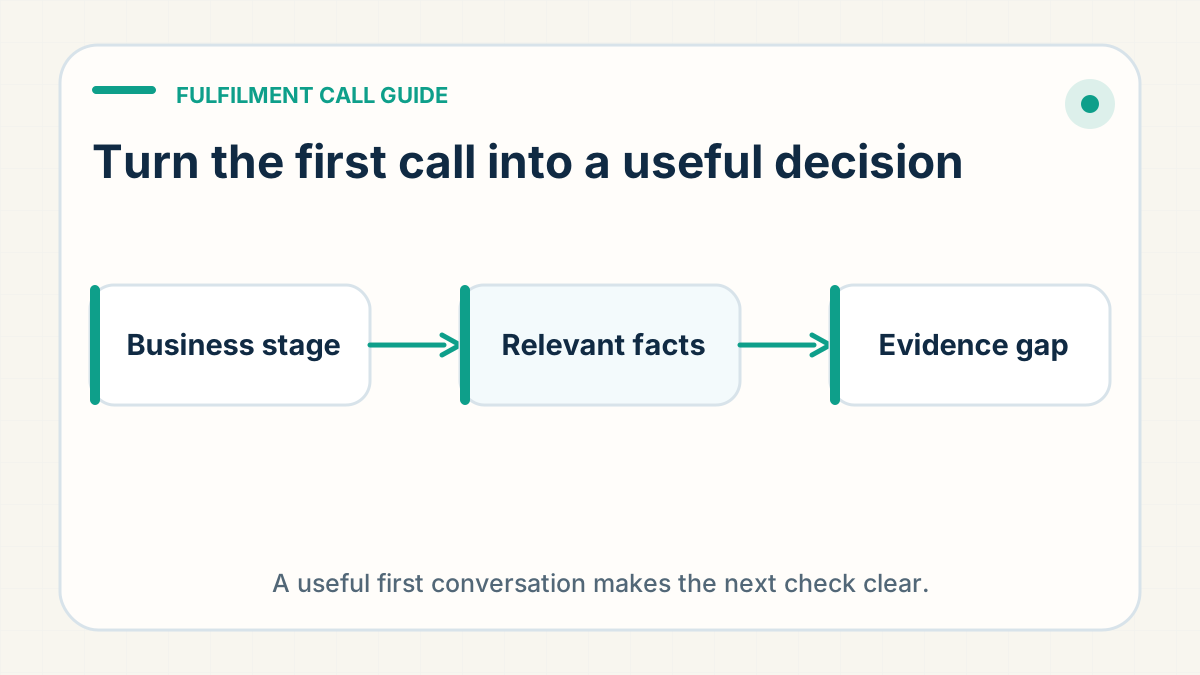
A first fulfilment call is most useful when it begins with the decision a seller is trying to make. Are you testing demand, replacing a supplier, preparing a repeatable fulfilment setup, or solving a delivery problem? That context changes which questions matter and prevents a conversation from becoming a generic tour of services.
Bring the facts that affect the answer
You do not need a perfect brief. A broad product category, likely destination markets, expected order stage, delivery priority, packaging requirement and any non-negotiable quality point are enough to start. If a product is still being developed, say what needs to be verified through a sample, actual photo, measurement or document rather than presenting an assumption as settled fact.
Ask for evidence of a live operation
A warehouse photograph proves that a photograph exists. It does not prove that the provider can receive your exact product, keep variants straight, release an order on time or own an exception after dispatch. Ask for the evidence tied to your decision: a current packed quote, a sample or receiving record, a representative tracking path on the lane, and the person who owns the next check when the normal flow breaks.
Make every number show its business model
"Free sourcing", "no monthly fee" and a single landed figure can all be genuine and still leave the economics unclear. Ask which parts of the quote cover the product, supplier work, inbound movement, receiving, QC, picking, packing, storage, branded materials, international shipping, duty, payment fees and currency conversion. You do not need every provider to charge the same way. You need enough labels to compare the same customer-ready order.
Test exception ownership before the first exception
Give the provider one realistic failure path: the supplier changes a component, a paid order reaches an unavailable variant, tracking stays quiet after label creation, or a customer reports damage. Ask who investigates, which evidence they return, when the seller hears again and what remains the seller's decision. A polished normal-order demo says little about the handoff that will consume your time when the order stops being normal.
Protect the exit while trust is high
Before sending meaningful stock, store access or custom packaging, ask what you can export and move if the relationship ends: supplier references, approved specifications, inventory by SKU and state, open orders, tracking, billing history and unused branded materials. Then run the fuller provider-resilience check. A cooperative answer before onboarding is more useful than discovering the boundary during a dispute.
A useful call ends with one next decision
The outcome should be a specific next step: request a sample, check a route, compare two supplier options, confirm whether an item is eligible, or write the handover rule for orders. A concise follow-up should record what is known, what still needs checking, who owns it and when the seller can expect an update. That is more valuable than a confident promise with no operating path behind it.