Sunyou (also written SunYou or Sunyou Post) is a Shenzhen-based cross-border logistics company that moves ecommerce parcels from China into destination-country postal and last-mile networks. If you have ordered from AliExpress, Temu-era marketplace sellers, or a small independent store, you may have seen its tracking prefixes or the sypost.net tracking page.
This overview explains what Sunyou is and where it fits. Each narrower question has its own guide: is Sunyou shipping legit, how to read Sunyou tracking and Sunyou vs 4PX vs YunExpress. For two specific lanes, see Sunyou and Latin America and Sunyou special goods.
What is Sunyou, and when does it fit?
Sunyou is a real carrier and can be a practical option for inexpensive, low-urgency cross-border parcels. It is not a premium courier replacement. Its lower-cost services can involve a hand-off to another postal or local carrier, with fewer tracking scans after export. That trade-off can work for a low-value test order, but it is a poor match for an expensive product, a launch with a tight delivery promise, or a customer who expects door-to-door event tracking.
Sunyou's own tracking site accepts up to 100 numbers at once and publishes customer-service contact details. The named Shenzhen company and its working tracking network are what separate a logistics operator from a fabricated tracking scheme. Neither point guarantees the outcome of any one parcel. In April 2025, Shenzhen Sunyou Cross-border Logistics made a Hong Kong listing application. As of 18 October 2026, hkexnews.hk lists that application as lapsed.
Why can a real Sunyou parcel look stuck?
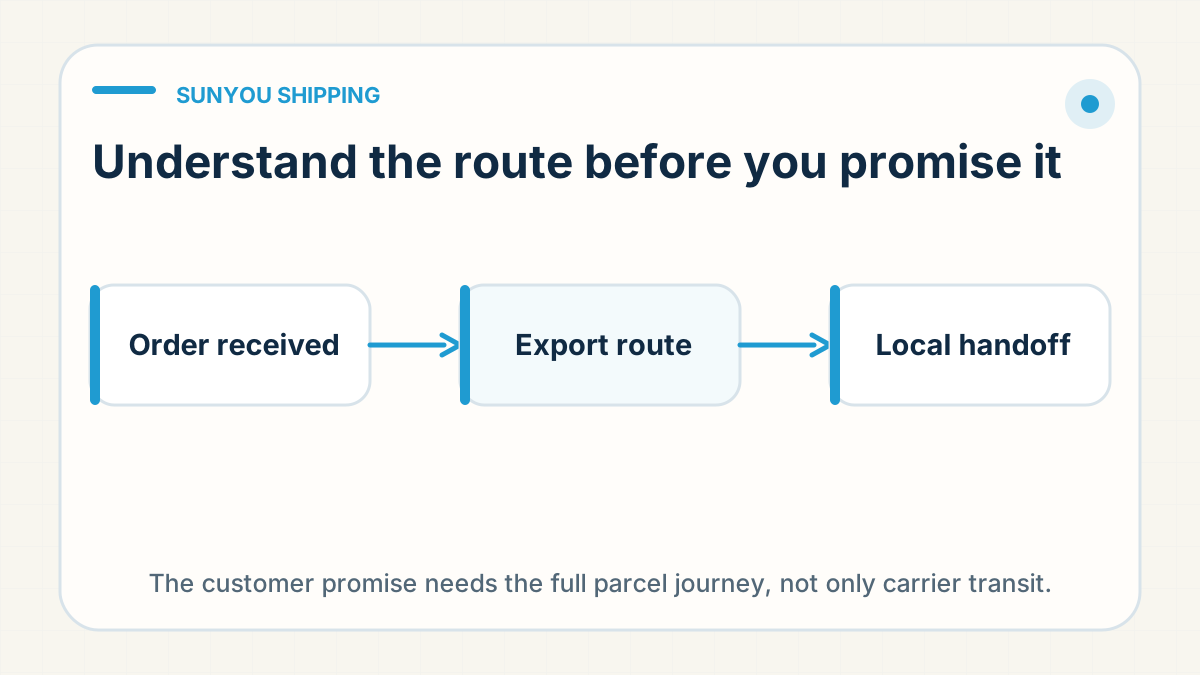
Most confusion comes from the network design. A parcel may be collected in China, processed at an export hub, move line-haul to the destination region, clear a border process, and then be injected into a local carrier's network. The scan rhythm changes at each hand-off.
On an economy route, a tracking number may show detailed origin scans and then become quiet after export. In some cases the delivery carrier uses a different reference number, or only supplies milestone scans rather than a full chain of events. That is frustrating for the buyer, but a quiet status alone is not proof that the package is fake.
Treat tracking as evidence, not a promise. Check the carrier's own tracker first, compare the last event with the dispatch date, identify the destination delivery partner if shown, and use the store's delivery window rather than a single scan to decide when intervention is needed.
Where does Sunyou make sense?
Sunyou is most defensible where the seller has deliberately chosen an economy service and explained the trade-off. It can suit low-ticket, lightweight products; non-urgent orders; a product-country route you have already tested; and a compliant product with the right documentation.
It is less suitable for high-value orders, time-sensitive gifts, products with high chargeback risk, or a store that cannot support customers during a longer and less transparent transit period. Those orders normally deserve a better-tracked line, a faster service, or stock placed closer to the customer.
What do special goods need before they ship?
A specialist-compatible route is not a shortcut around regulation. Batteries, cosmetics, liquids, magnets and other sensitive categories need a route-specific eligibility check, correct paperwork and honest product declarations. Always validate the actual product composition, battery configuration and destination restrictions before selecting a service.
What should you tell customers before checkout?
The best time to reduce a "where is my order?" ticket is before the sale. Do not label an economy service "express," and do not promise an arrival date you cannot control. State processing time separately from transit time, show a destination-specific delivery range, and say when tracking may update less often after export.
Useful checkout language is simple: Economy tracked shipping. Dispatch in 2–3 business days. Tracking can update less frequently after the parcel leaves China. Delivery estimates vary by destination and customs processing.
What should you check before you choose Sunyou?
Before allocating a route, check five things:
- Product eligibility.
- Destination import rules and tax treatment.
- The tracking expectation.
- The customer promise shown at checkout.
- The fallback plan for a delayed or lost parcel.
Keep the dispatch record, tracking history and customer messages together so a carrier trace or replacement decision is straightforward.
What changed for US-bound parcels in 2026?
For US-bound low-value parcels, the old assumption that all qualifying small shipments arrive duty-free is no longer safe. US Customs and Border Protection says duty-free de minimis treatment was suspended globally from 29 August 2025, with duties, taxes and fees potentially applying. That makes customs data, landed-cost planning and compliant service selection more important than chasing the lowest sticker price.
So when should you use Sunyou?
Sunyou is legitimate and can be useful, but it is a route choice rather than a brand promise. Use it where economy shipping genuinely fits; use a stronger service where visibility, speed and customer confidence matter more. At RyanFulfil, we select the route against the product, destination and customer promise before dispatch.
The rule: Choose the named Sunyou service, not the brand in the abstract. Confirm the customer-ready item, destination, packed size, milestone visibility and current exception route, then compare that complete service with the promise shown at checkout.
Waiting for a parcel you bought? Contact the store you ordered from: it holds your order details.
Need one order or route checked?
Worried about an order's tracking? Send us the order number on WhatsApp (wa.link/dropship) and we'll check what's going on.
Check Order on WhatsApp →