The direct answer
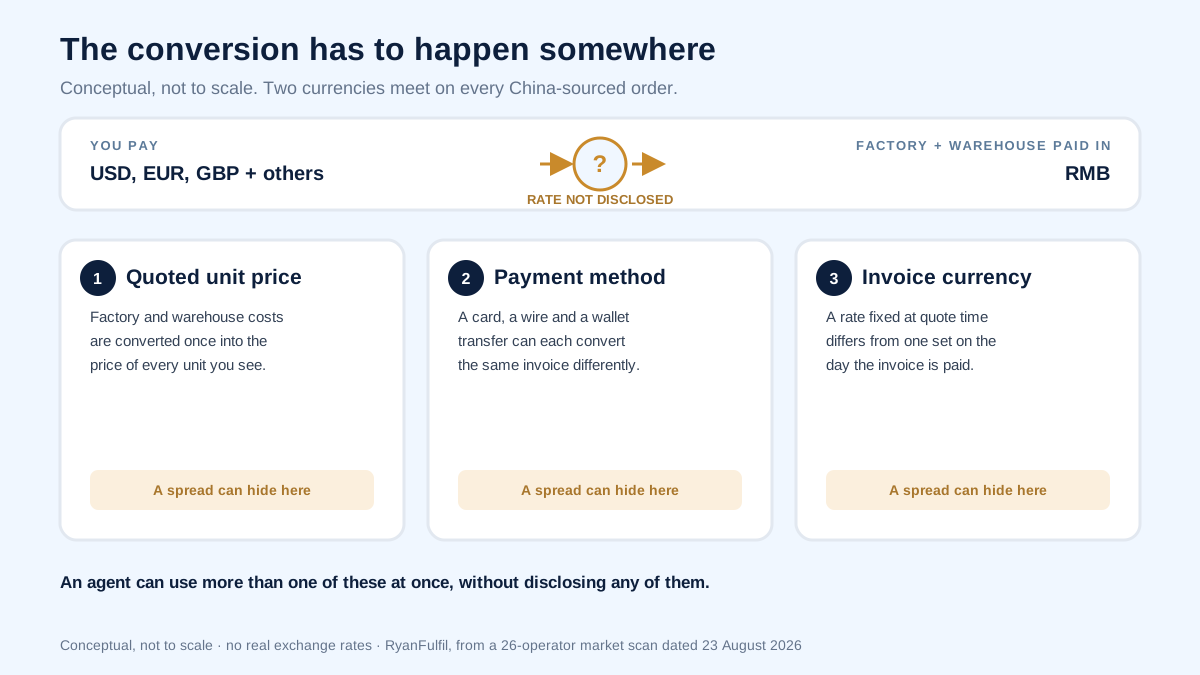
A China-sourced order is paid for in two currencies. You pay in dollars, euros or another currency; the factory and the warehouse are paid in RMB. Somewhere between those two payments, your agent converts one into the other, and the rate used for that conversion is a real cost. A market scan of 26 China-based sourcing and fulfilment operators, dated 23 August 2026, found that not one of them publishes how it sets that rate.
Ask your agent two things before you accept a quote: what rate was used, and what it was checked against. Then run the check yourself against the mid-market rate on the invoice date, which takes under a minute on any currency-conversion site. This guide shows the mechanics, a worked sum with invented numbers, and the four questions that get you an answer.
What the scan found, and what it did not
The scan covered 26 China-based sourcing and fulfilment operators publicly serving small e-commerce sellers, each entry graded by the evidence behind it and dated 23 August 2026. Four of the twenty-six publish enough numerical handling and storage detail to model a basic warehouse bill. None of the twenty-six publish a foreign-exchange spread or a repeatable method for setting one.
That is not evidence that any operator is overcharging on currency. It is evidence that the number is not checkable from outside, for any of them. A rate you cannot see is a rate you cannot compare, and the only two ways to close that gap are to ask the agent directly or to test an invoice against the market rate yourself.
Where the conversion sits
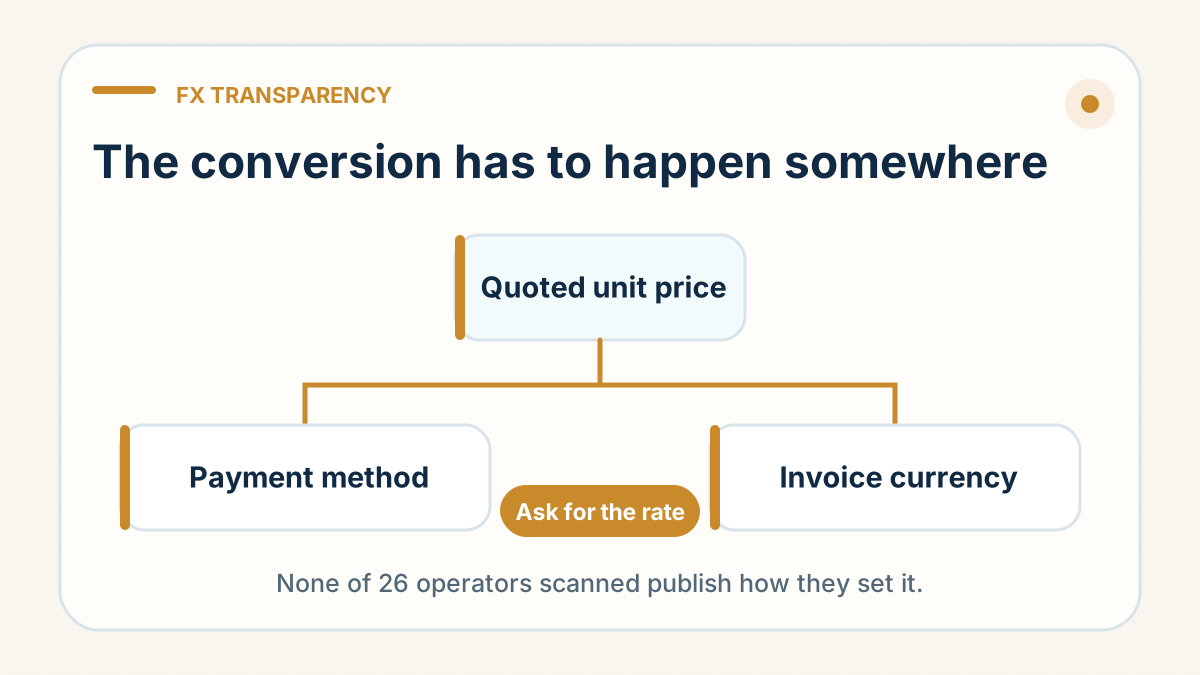
The conversion is not one line item. It can sit in the unit price you were quoted, in the payment method you are offered, or in the currency your invoice is issued in, and an agent can use more than one at once without saying so anywhere.
- In the quote: a landed-cost figure is built from factory and warehouse costs in RMB, converted once to price the quote in your currency. If that internal rate carries a spread, it is baked into every unit price you see.
- In the payment method: a card payment, a bank wire and a wallet transfer can each convert at a different rate, so two payment methods for the same invoice can cost two different amounts.
- In the invoice currency: a rate fixed when you accepted the quote behaves differently from one set on the day the invoice is paid, especially over a production lead time.
A worked example, with invented numbers
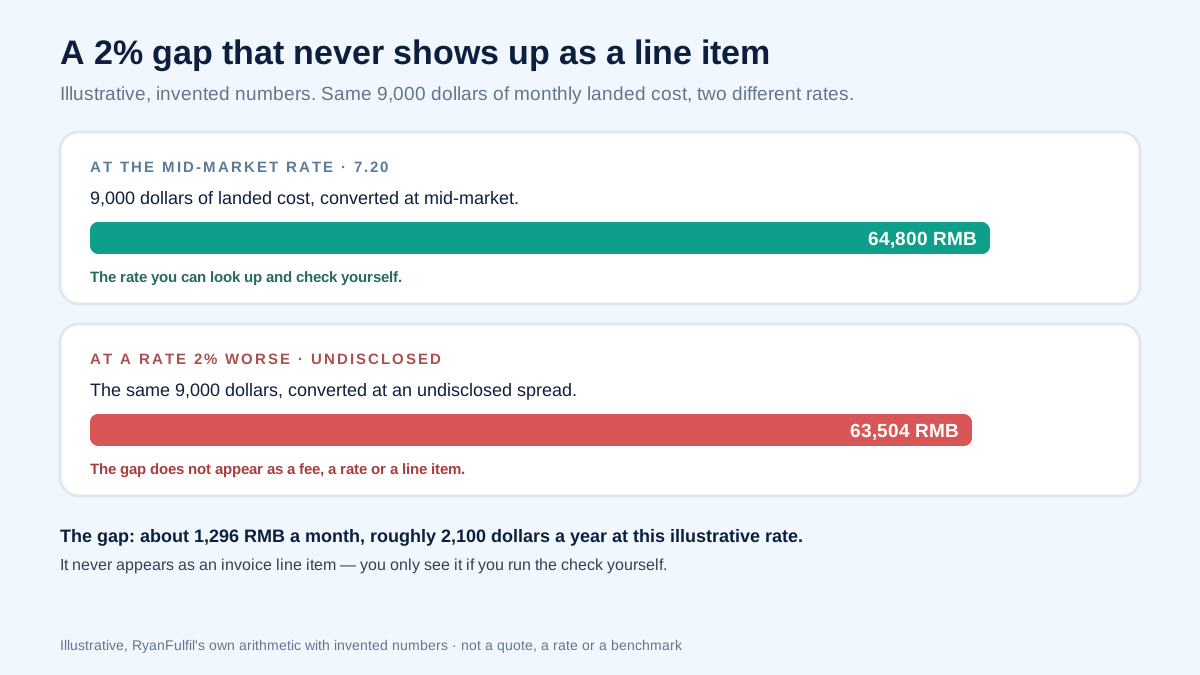
Here is the arithmetic, with invented numbers to show the shape of it. Say your total landed cost across every order this month is 9,000 dollars, all of it ultimately paid to factories and a warehouse in RMB. At a mid-market rate of 7.20, that is 64,800 RMB of goods and service. If your agent's effective rate is two per cent worse than mid-market and it is not disclosed, the same 9,000 dollars only buys about 63,504 RMB once converted — a gap of roughly 180 dollars that month, or a little over 2,100 dollars across a year at the same volume.
Two per cent is an illustration, not a benchmark; none of the 26 operators in the scan publishes a figure to compare it against. The point of the sum is not its size. It is that the gap does not appear as a line item, a fee or a receipt. It only shows up if you run this calculation yourself, and it repeats every month for as long as you use that agent.
Four questions that get you an answer
- What rate did you use on this invoice, and on what date? A rate fixed at quote time behaves differently from one set at invoice time, and only one of those protects you from a currency move in between.
- What is that rate checked against? The mid-market or interbank rate is the one benchmark you can look up yourself, in seconds, for the same date.
- Is the spread the same across every payment method, or does a card, a wire and a wallet transfer each carry a different one?
- Can you show me an existing account's rate against the mid-market rate on the same day? An agent that already discloses this to current customers can answer in one message. One that has never been asked will need time to find out, which is itself an answer.
Where RyanFulfil fits
RyanFulfil already answers the first question by currency rather than as one blended rate: quotes in US dollars, euros, sterling, Canadian, Australian and New Zealand dollars, and Singapore dollars carry no FX surcharge; Turkish lira and Hungarian forint carry a small one. That is a published policy, not a rate on a specific invoice — run the mid-market check above on your own invoice regardless of who quotes it. A policy and a checked invoice are two different kinds of proof, and this guide is asking every agent, us included, to give you the second one on request.
The currency line is one field in a longer list. If you have not read it yet, what to cover in your first fulfilment call sets out the rest — evidence of a live operation, what every number in a quote covers, and exception ownership — and how to read a landed-price quote from a China fulfilment agent works through the other six fields a quote should carry.
Do this before your next quote
- Ask what rate was used and what date it applied, in writing, on your current or next invoice.
- Look up the mid-market rate for that same date and compare it to the rate you were charged.
- Ask whether the rate changes by payment method, and get the answer for each method you might use.
- Multiply any gap you find by your monthly landed cost, not just one invoice, before you decide whether it matters.
- If the agent cannot answer within a few days, treat the silence as the answer and price it into your decision to stay or move.
Download the blank FX rate check log. One row is one invoice: the date, the currency, the rate you were charged, the mid-market rate for that date, and the gap between them. Fill it in for three invoices before you decide whether the gap is worth raising.
What to watch, what to ignore, what we could not find
- Watch: whether any operator in this market starts publishing a reproducible FX method over the next year, and whether your own agent's answer changes when you ask a second time.
- Ignore: "we don't charge FX fees," on its own, without a rate and a benchmark attached — a spread built into the unit price carries no fee to point to.
- Could not find: any of the 26 operators sampled publishing a foreign-exchange spread or method; an industry-standard spread to compare against, because none is published; or evidence of how any specific operator sets its rate day to day.
Check it, do not just ask about it
A rate you cannot see is a rate you cannot compare, and asking the question is only half the check. Look up the mid-market rate for your last invoice date, compare it to what you were charged, and multiply the gap by a year of volume before you decide it is too small to matter.
Here is how you would prove this guide wrong: if an agent's disclosed rate matches the mid-market rate on the invoice date, for more than one invoice in a row, the gap this guide describes is not costing you anything, and the four questions above cost you five minutes to confirm it.
Evidence boundary
Last verified 13 September 2026.
The finding that none of 26 sampled China-based sourcing and fulfilment operators publishes a foreign-exchange spread or method, and that four of the same 26 publish enough numerical terms to model a basic warehouse bill, is read directly from a market scan of those operators dated 23 August 2026, graded by evidence type; it is a market description, not a ranking or a recommendation, and it does not name which operators were checked for this specific point beyond the count.
RyanFulfil's own currency policy — no FX surcharge on USD, EUR, GBP, CAD, AUD, NZD and SGD quotes, a small one on TRY and HUF — is published in its agency quoting guidance and applies to RyanFulfil's own quotes; it is not a claim about any other operator.
Every dollar, RMB and percentage figure in the worked example is invented to show the arithmetic and is not a quote, a rate or a benchmark. We did not test any operator's actual conversion rate for this guide, including our own; the check this guide recommends is one every reader can run on their own next invoice, and we would rather you ran it than took our word for the answer. Re-read this if the market publishes a standard FX-disclosure benchmark, or after you have checked your own rate against the mid-market figure.
Need a product checked before you spend on ads?
Send us the product link and destination on WhatsApp (+86 178 4666 9989). We will help you assess sourcing, packing and shipping before you commit.
Get Sourcing Quote on WhatsApp →