From the operations desk
Monday's failures were formats, not silences
Monday ran at full weekday volume and almost every question got an answer, so the day's failures were not silences. They were formats. The exchanges that had stalled and then moved were the ones where somebody stopped writing sentences and sent something to be filled in or marked up: a blank field, a drawing to mark a dimension on, a fixed list to report against. The ones that stayed stuck were answered with a number, a category or a manufacturing term the other side could not act on, and the asking had to start over.
A picture of the deliverable beats the word for it
A custom-merchandise specification had been running across both of this desk's last two weeks when the buyer's patience ran out and he asked for a single list of everything still outstanding. Most of what was missing turned out to be ordinary product content nobody had asked for until that evening: whether the whole run was one colour, and the split between men's and women's. The stuck requests, though, were stuck on vocabulary alone. The desk had asked for the artwork in a production format, naming it the way a factory does, and got a question mark back; it asked for the dimensions to be marked on the drawing, and the buyer asked what that meant.
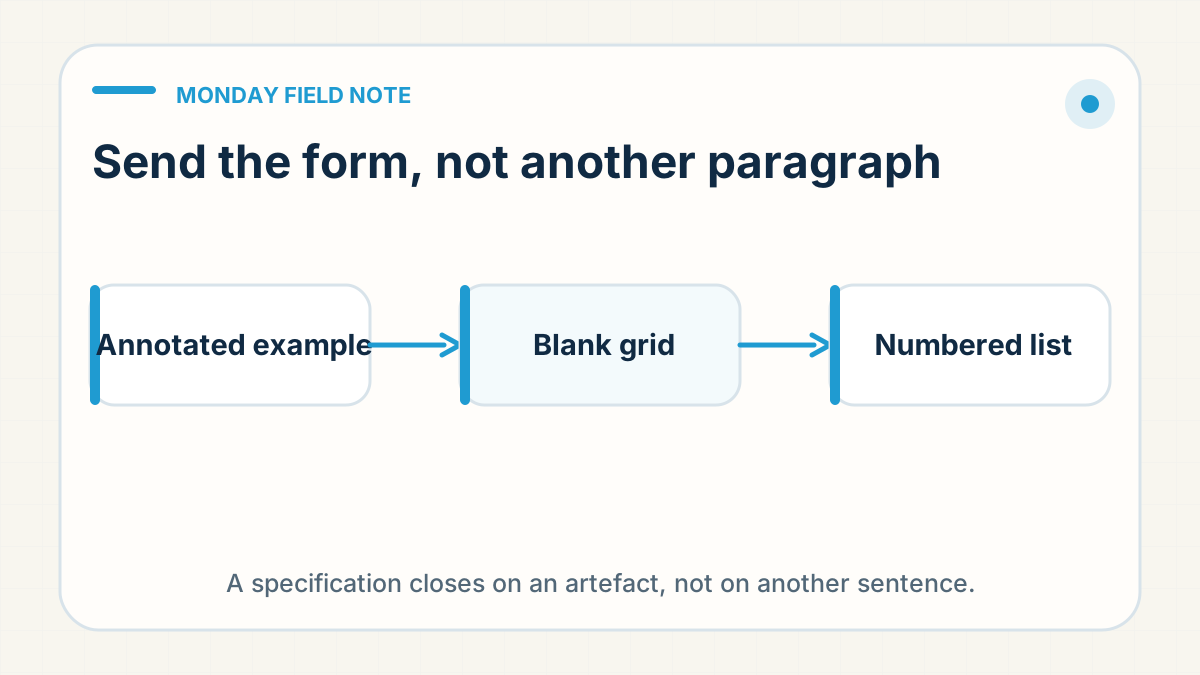
Both of those cleared on an artefact. An annotated example image, sent as a question rather than an instruction, brought the buyer's own marked-up file back within minutes. The next request went out as an empty grid — women's and men's sizes, one blank cell each — and the per-size split that prose had never produced was on the record within the quarter-hour. The same move works in the dullest place on the desk: a repeat client who was sent a blank labelled form for his delivery address returned it complete before the conversation had moved on. The sizes and quantities were confirmed and sent to the manufacturer the same evening, with the logo files still to come and the quote to follow the next morning.
A count is not a list, and a confirmation is not a check
Answers went out that looked finished and could not be used. A repeat seller sourcing for Spain asked which variants a product came in and was told how many colours there were, none of them named; he then had to ask whether the white he had planned to list existed, and it did. On a phone-case line, a seller's substituted designs were confirmed as applied to an open order early in the morning and withdrawn before the morning was out, because the design is not made for that handset model. The confirmation had been checked against the order, never against the product.
So ask for the variants by name and the model each is made for, checked against the product rather than your order line. The safe substitution process sets out where that check belongs.
Ask in the shape you will use the answer
The desk ran the same discipline in reverse. A prospect with no orders yet was quoted a near-match instead of his exact product, was told so plainly, and sent candidate pictures back asking which had been priced; the confirmation was one word. Later that evening, before the verified quotation went out, the internal request was issued as a fixed list rather than as a question: verify the selected item, then report the price, the shipping cost with its delivery window, which colours and sizes exist, the material and specification, whether the supplier has it, and any minimum order quantity.
That list is the thing to copy: it is already the shape of the answer. Send a sourcing request as a brief before you ask for a price; what a brief cannot govern once a thread is running is the form of the reply, so name that too: one line per fact, variants named rather than counted, every figure labelled with its lane.
The labels on an answer are part of the answer
One Monday quote was built properly and still carried an uncaught defect. The material was named, a standard and a faster channel each carried its own working-day window, product and shipping sat in one figure, and the European per-customs-item duty was a stated line rather than a later addition. But one caption on it did not match the intake line the thread already carried, and nobody reconciled the two before he went away to evaluate the offer.
Ask what your partner checks before quoting
One message gets it: the facts they verify about a product before a quotation goes out — ask whether it is written down. Then read that against your own needs, because a list built for quoting is not a list built for your catalogue. If a variant-level stock check against your exact model is not on it, ask for it to be added, because a confirmation given before that check runs has to be taken back later. The second thing to ask for is a habit rather than a document: the labels your own request already carried, and the lane each figure belongs to, repeated on the line that carries the figure, so a mismatch surfaces while the quote is still a draft.