Field note
What was happening
Sellers spent 1–7 November 2026 asking what a number really covered. Quotes met a lower figure from somewhere else. Labels met a printer's minimum. Invoices met a parcel that weighed more than the sheet said. New EU lines and peak-season costs sharpened every one of these questions.
The chats ran across hundreds of conversations, and the busiest days fell between Monday and Friday. Sunday stayed quiet. Most new sellers came with a product link and one question about the delivered price. These are pooled patterns, not the story of one identifiable account.
The theme of the week
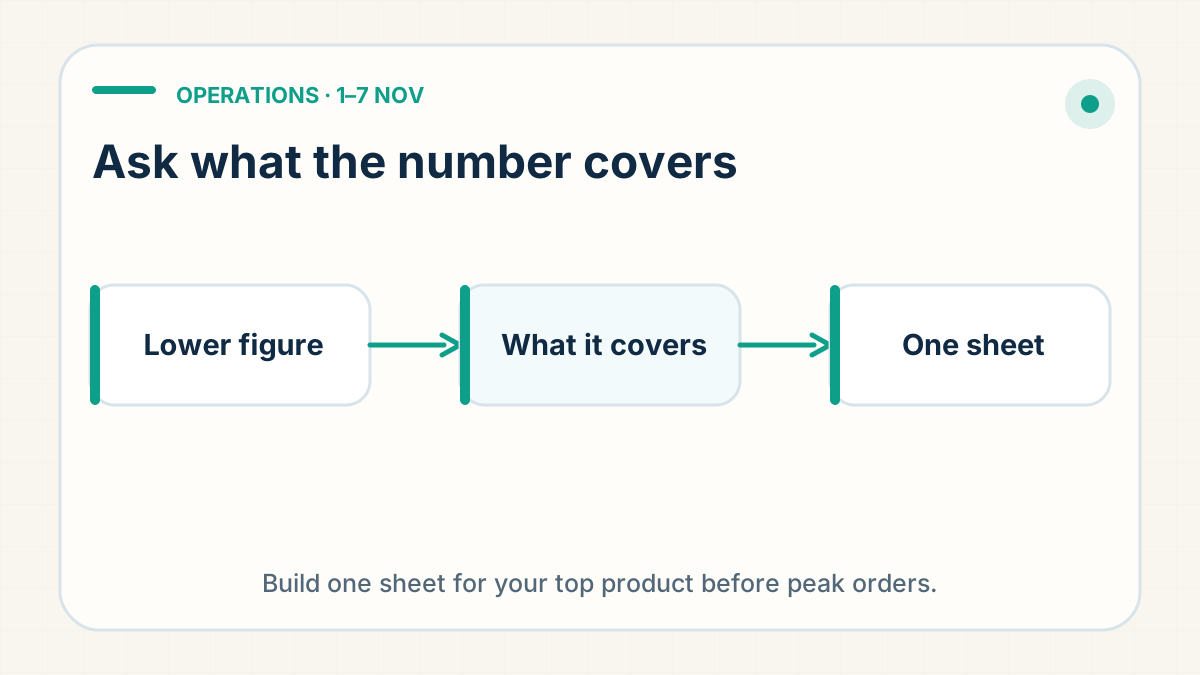
One sentence covers the week: a figure means nothing until you know what it covers. Each question below started with a number that looked wrong and ended with a clearer list of what the number included.
Why did so many quotes look high?
At least eight separate sellers set a quote of ours against a lower figure from AliExpress, Taobao, a marketplace or another agent. Some of those figures covered the product alone. Some were real, and we said so. Compare the same parcel, then decide: the guide now answers why AliExpress can come in cheaper and whether an agent should always beat it.
Where does no minimum stop?
At the printer. Labels, cards and printed bags each carry their own run, as Thursday's note sets out. Ask for one line per branded item before you pay for artwork.
What did the first parcels show?
They showed which pack could not take the trip. Wednesday's note follows the switch from mailer to carton, including the supply and the weight that come with it.
Why did shipping move in November?
Carriers measured harder, and weight bands moved prices unevenly. Friday's note gives the column to ask for on every invoice and the check to run before you reprice.
What did sellers ask about their own stock?
At least six sellers wanted to send stock from their own supplier into our Guangzhou warehouse, and two of them asked for a shipping mark for the cartons. You do not need a formal one. The own-supplier guide now says what to write and what to tell us instead.
What repeated from last week?
The EU line kept coming up as sellers saw their first November invoices. For parcels up to €150, the line is €5 per declaration line. The FAQ on the EU charges explains the count, so check with us before you price a set that mixes products.
Another question came up beside it: whose IOSS number goes on the parcel? We normally use the shipper's, and the new FAQ answer covers the other option and what your quote will say about VAT.
Chinese New Year also appeared in planning questions, three months ahead. A seller asked whether to keep placing orders until January or stock up first. The answer on public holidays is the place to start, and the date to get from us is the last working day before the closure.
What else slowed a launch?
Supplier stock ran short across several accounts, and a colour or size that sold last month came back unavailable. Ask for the replacement date, not only the status, and decide whether to wait, swap or refund. The stock-out guide lists the choices you can ask for on each order.
New sellers also asked how to connect a store, usually after the first quote. The usual Shopify route takes three steps on your side: install the order-management app we name in your group, generate a collaborator code and share it with your store domain. The answer on Shopify covers it, and spreadsheet orders work while your volume stays small.
Where the conversations actually sat
New-seller threads carried most of the price questions, while running accounts carried the weight, packing and invoice questions. Sellers with live ads pushed hardest on timing. Several wrote out a per-order table for one, two and three pieces, with product and shipping apart. That table gave us something to price line by line.
What to carry into next week
Build one sheet for your top product before peak orders arrive. Give it six rows, and fill each row with a number from us, not an estimate:
- The delivered price at one, two and three pieces, to each main country.
- The lines your quote shows apart, such as the EU line, and what each one covers.
- The packed weight and box size of the current batch.
- The pack each order leaves in, with one photo.
- Each branded item's minimum, price and production time.
- The lower figure you have found elsewhere, with its link and checkout total.
Then tell us the gaps. A sheet like this turns the next price question into a short message, and it leaves you with figures you can trust when orders jump.
Need a quote for your own store?
Find a product from a photo, check one-piece fulfilment or prepare a private-label brief.