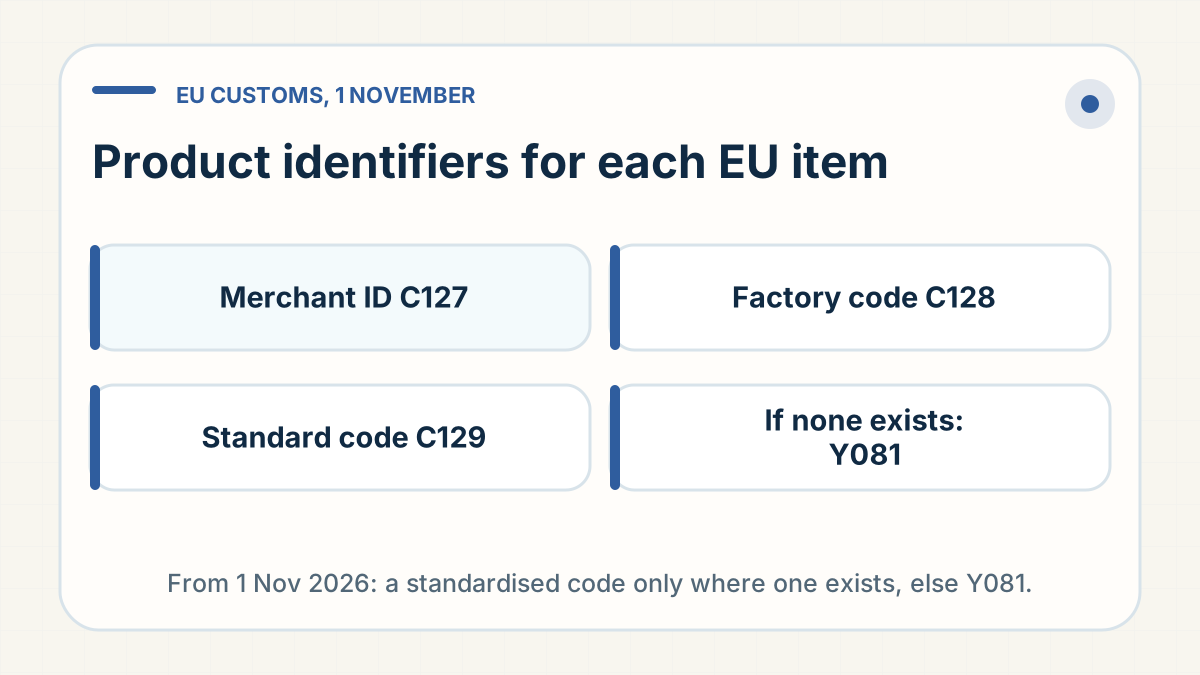
From 1 November 2026, EU customs declarations for goods sold in distance sales of imported goods must carry, for each item, the merchant's product identifier, the manufacturer's own code and, only where one exists for the item, a standardised manufacturer identifier; where none exists, the declaration carries code Y081 instead. The requirement has no value threshold, so it reaches China-to-EU orders sold this way whatever their price. Declaring the identifiers has been voluntary since 1 July 2026; from 1 November it is enforced.
What changes on 1 November 2026?
Commission Delegated Regulation (EU) 2026/1022, published in the Official Journal on 1 July 2026, adds the three identifiers to the data a customs declaration carries. Its Article 2(3) applies the requirement from 1 November 2026 and lets operators provide the data voluntarily from 1 July 2026. The act has been corrected since publication: a correction of 3 July 2026 set its adoption date to 30 April 2026, and a second, of 4 August 2026, was published only in German and Dutch.
The Commission's guidance (version of 2 June 2026) says no sanction, penalty or other measure may be taken for missing or incorrect data during the voluntary period, and that effective enforcement starts on 1 November. It does not state a penalty amount. The guidance is explanatory and not legally binding; the Official Journal text is the authentic one.
Which orders does it cover?
It covers goods sold in distance sales of imported goods, the VAT term set out in Article 14(4) of the EU VAT Directive, not every import. The act's title refers to the temporary €3 duty on consignments up to €150, but the identifier requirement has no value threshold: the Commission's questions-and-answers document says it applies "without value distinction".
The €3 duty, by contrast, is charged per customs item; see how the €3 duty applies per customs item. For VAT and duty on EU orders, see our EU import tax answer.
What are the three identifiers, and what do you supply for each?
- Merchant product identifier (code C127): the identifier assigned by the online seller, marketplace or platform. Commission guidance adds that it is expected to be unique on that site, however many sellers offer the product, and accessible to customers. On a marketplace, use the identifier the marketplace gives the product itself, the same for every seller of that product and usable by customers to find it on the site, not your own seller code and not a per-seller offer or listing number. On your own store, use a stable model- or variant-level identifier that customers can see and search on your site.
- Non-standardised manufacturer product identifier (code C128): a code assigned by the manufacturer, producer or product supplier that does not rely on an internationally recognised standard. In practice this is the factory's own model or item code.
- Standardised manufacturer product identifier (code C129): a manufacturer's code that does rely on an internationally recognised standard. It is required only if one exists for the item; where none exists, the declaration carries code Y081 instead. In Europe the most common standardised identifiers are the EAN (European Article Number) for many products and the ISBN for books, and other standards exist. If the manufacturer has given the product an EAN (usually printed as a barcode on the product or its packaging), that is its standardised identifier: declare it rather than coding Y081.
Where one declared item contains several products, such as a bundle or set, the identifier of each product is reported. The guidance also warns that deliberately using identifiers that defeat the purpose, such as a batch or unit number where a model-level one exists, will as a rule be treated as an infringement.
Section 3.5.7 of the guidance sets an administrative tolerance by commodity code, for goods such as unprocessed agricultural products in Chapters 1 to 15, certain hand-made goods, and antiques, collectibles and art: for those, the merchant identifier in C127 and the manufacturer's own code in C128 are deemed to comply. It is not a general exemption or extra time, and the code list is not exhaustive. Second-hand, refurbished, custom, personalised and print-on-demand goods must comply, for example with the identifier of the original product or of the underlying textile. Separate rules for the standardised identifier apply to medical devices and over-the-counter medicines.
How do the identifiers reach the declaration, and with which codes?
The identifiers go on the customs declaration lodged for your parcels, and whoever lodges it can only declare identifiers that reach it. This guide does not settle which party lodges it on a given route. Ask your fulfilment provider or carrier who lodges the declaration for your parcels, and get written confirmation that the identifiers you send will be passed on.
Commission guidance says the codes C127, C128, C129 and Y081 go in data element 12 03 000 000 'Supporting document' whenever additional procedure code F48, F49 or F53 is used for distance sales of imported goods. The element is repeatable. The codes could be declared from 1 July 2026 and enter the EU's TARIC conditions from 1 November.
What should you check before 1 November 2026?
- List every product variant you sell to EU consumers with its merchant identifier. On a marketplace, use the identifier the marketplace gives the product itself (the same for every seller of that product, which customers can use to find it on the site), not your own seller code or a per-seller offer or listing number; on your own store, use a stable model- or variant-level identifier that customers can see and search on your site. Never use batch, unit or per-order codes.
- Ask each factory or supplier, in writing, for its own model or item code and for its standardised identifier where the product has one, such as an EAN or ISBN printed on the product or packaging.
- Declare the manufacturer's EAN (or other standardised identifier) for any item that has one; mark only items with no standardised identifier for Y081; and check commodity codes against section 3.5.7 rather than assuming the tolerance applies.
- For a bundle or multi-product SKU, give each component product its own row with its own identifiers.
- Send the table to your fulfilment provider and confirm in writing how it reaches whoever lodges the declaration, whether C127, C128 and C129 are already sent, and in what format the identifiers are needed with each order.
- Start sending the identifiers now. While missing or wrong data cannot be sanctioned (until 31 October 2026), sending now lets you correct your data before enforcement starts.
- The value to obtain: a SKU-to-identifier table for every EU-bound product, with one row per component product for bundles, giving the merchant identifier, the manufacturer's code and the standardised identifier (or Y081), confirmed by your fulfilment provider before 1 November.
As of 5 October 2026 we found no Commission notice postponing the 1 November date, though that search was not exhaustive. This rule and other dated changes, each with its official source, are on our seller rule and fee changes calendar. This guide is a planning summary, not legal or customs-brokerage advice.