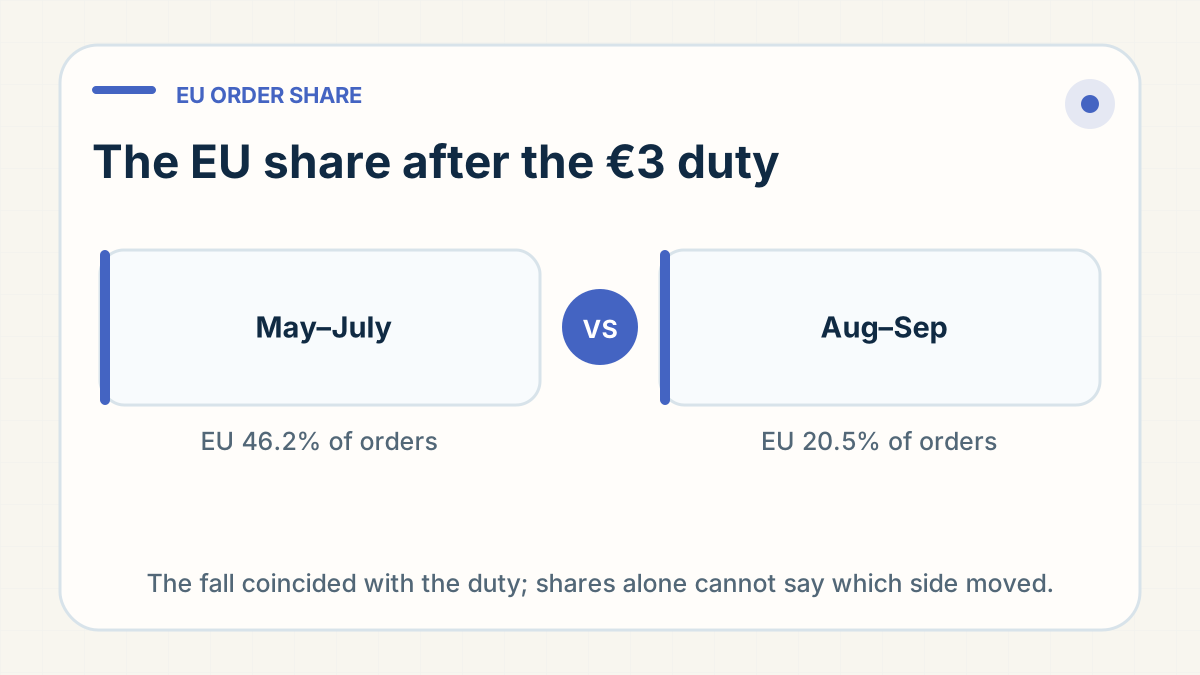
In RyanFulfil's paid orders recorded, the EU share of orders stayed high in July 2026, the first month of the EU's €3 duty, at 49%, then fell to 23.7% in August and 17.3% in September. Across May–July the EU took 46.2% of orders; across August–September, 20.5%, while the US share rose from 24.4% to 39.9%. The fall coincided with the duty, and shares alone cannot say whether EU orders fell or US orders rose.
Did the EU share of dropshipping orders fall after the €3 duty?
The combined EU share of our orders fell from August rather than July. The fall is spread across sellers rather than one store leaving. Both teams' EU shares were lower in August–September than in May–July: in DropFulfill (Team A) from 52.0% to 22.3% of orders, in YR Fulfill (Team B) from 34.1% to 16.6%. The UK share was about 7–8% in both periods, May–July and August–September.
What exactly does the €3 duty charge?
Council Regulation (EU) 2026/382, adopted in February 2026, sets a temporary customs duty of €3 per item on consignments with an intrinsic value up to €150, applying from 1 July 2026 to 1 July 2028. The European Commission's customs guidance of June 2026 applies it per declaration line, irrespective of the number of articles in that line. The charge therefore follows the number of distinct customs lines in a parcel, not the parcel itself and not its unit count. Of our EU orders paid 1 May – 3 October 2026, 98.7% carried a recorded order value under €150. That is a recorded-value flag, not a customs declaration.
The €3 duty is separate from IOSS/VAT and is included in RyanFulfil's all-in quote for the applicable EU route. For worked bundle examples and what counts as one line, see the €3 customs duty explained per item and the EU import tax answer in our FAQ.
What did Dutch Customs see after 1 July?
Dutch Customs (Douane Nederland) reported in September 2026, in a page published on 1 September and updated on 17 September, that e-commerce declarations in July and August averaged 46% below their January–June 2026 average. E-commerce declaration lines fell 70%. Standard declarations rose 20% over the same period, and their lines 30%.
In the same September 2026 report, Dutch Customs read this as fewer single parcels going straight to consumers, with more goods arriving in bulk and being stored in EU warehouses. It reported the same trend in France and Belgium, without figures for either.
What did the big marketplaces say?
On their second-quarter 2026 calls, as recorded in third-party transcripts, PDD Holdings, the parent of Temu, said cross-border orders in the affected markets would face lower fulfilment efficiency and higher costs, while Etsy's chief financial officer did not expect a big impact from the EU change. On its August 2026 call, PDD also said it is onboarding more local merchants and speeding up the build-out of local warehousing.
What should you check in your own EU orders?
Run three checks, then one decision, on your own EU orders for May to September 2026 before changing price, product or route.
- Monthly counts, not shares. Put your EU order count beside your US count for each month from May to September. If your EU count held while your US count grew, your EU demand did not shrink; your mix changed.
- Customs lines per parcel. Count the distinct customs lines in each EU parcel, not the units. Several units of one product can share one line; a basket that mixes products under different tariff codes adds a line, and €3, for each code.
- Basket shape. Find the share of your EU orders that mix products. If most are single-product parcels, the duty is close to a flat €3 per order; if many are mixed, test whether the extra lines still earn their margin.
Whether an EU stock point changes the arithmetic. Bulk stock already in the EU ships to the customer as a domestic parcel, which is the shift Dutch Customs described, but inbound freight and import costs, receiving, storage, domestic delivery and working capital replace the direct-parcel cost. It pays only for products whose EU demand is proven; compare the options in dropship, pre-stock or overseas warehouse with the same product and destination mix in each case.
For where the rest of the orders went over the same window, by region, category and order value, see where 197,000 dropshipping orders went from May to October 2026. The figures to obtain first are your own EU and US order counts for May–July and August–September (then the EU share, to set beside our 46.2% and 20.5%); then record the average number of customs lines per EU parcel in August and September, because that number sets what the duty costs you per order.