Field note
The situation
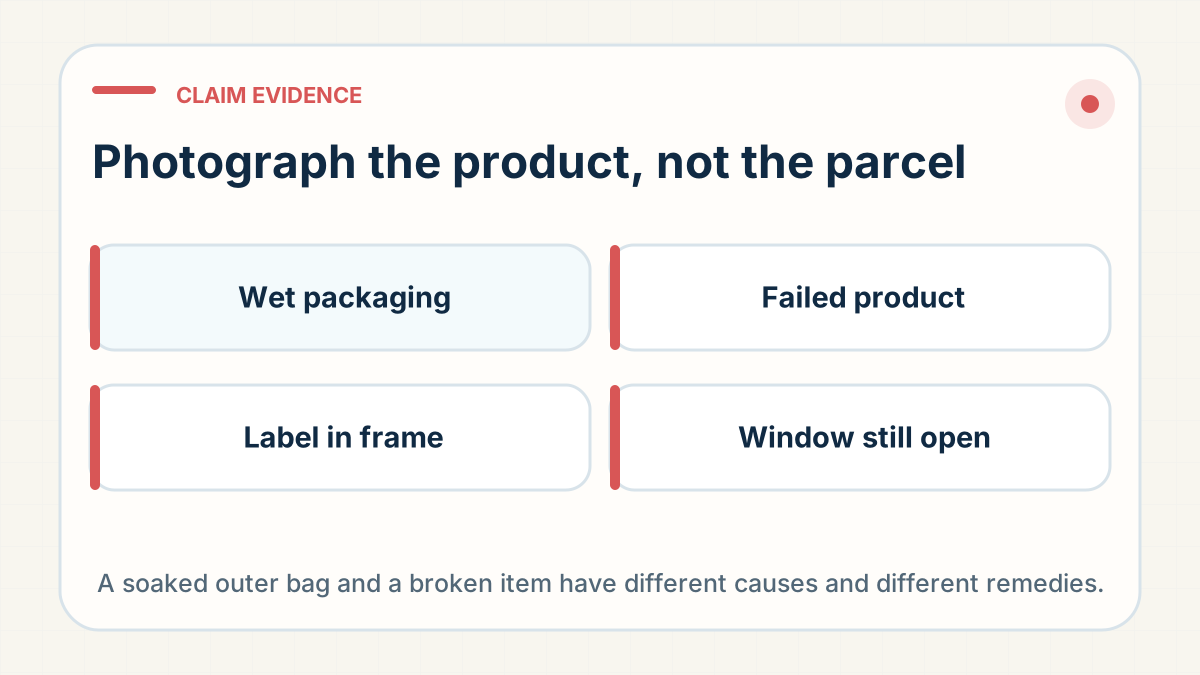
Photograph the product itself, not only the parcel, in the first days, because every claim runs against a clock. A customer reported an electrical item that had arrived in a wet outer package, with corrosion visible on a cable, and refused to plug it in. That is a completely reasonable position for a customer to take. It also left the claim resting on photographs that showed the packaging rather than the product, which is a genuinely difficult place to make a fair decision from.
- 01Capture the product itselfA wet outer bag and a failed item have different causes.
- 02Include the shipping labelTies the evidence to a specific order without a dispute.
- 03Resolve the first case fairlyEspecially where safety and fairness point the same way.
- 04State the standard and windowEvidence expires; say so while the goods are still fresh.
Wet packaging is a signal, not a finding
The distinction matters because the two states have different causes and different remedies. A soaked outer bag points at handling or weather in the delivery network. A failed product points at the item, the batch or the packing method. Photographs of an outer package cannot tell those apart, and neither can a strongly worded message. What resolves it is an image or short video of the item itself, ideally alongside the shipping label so identity is not in question.
Resolve the case, then fix the rule
The approach taken was to treat the first occurrence generously — a free replacement, without requiring the customer to handle a component they believed unsafe — and at the same time to state clearly what evidence would be needed if the same claim shape recurred. Both halves matter. Only the first half is customer service without a system; only the second half is a system with no customer in it. Where an electrical product is involved there is an additional reason to lean generous on the first case: the safe outcome and the fair outcome point the same way.
Every claim runs against a clock
The other recurring theme was time. Several threads this week concerned items delivered long enough ago that the supplier after-sales window had closed, including one missing-accessory report from months earlier with no photographs taken at the time. Those are the hardest conversations, because the customer is often entirely honest and the evidence has simply expired. The practical response is to be explicit about the window while goods are still fresh, so a seller knows to collect evidence in the first days rather than discovering the deadline after it has passed.
It is worth separating three different clocks, because sellers routinely assume there is only one. The marketplace or payment provider gives the customer a protection window. The carrier gives a much shorter window for lodging a loss or damage claim, after which a parcel is simply gone. And the factory gives an after-sales window of its own, which is usually the shortest and the least visible. An item can be comfortably inside the first and hopeless under the third.
A device fault is not always a device fault
A cluster of electronics complaints this week turned out to need triage before remedy. One unit would not finish starting up; one powered on only while connected to a charger; one had a control that behaved as though permanently pressed. Those read as three failures, and the supplier's first response to two of them was a diagnostic sequence rather than a replacement — remove the memory card and retest, force a restart, clear stored files.
That is not deflection when it is done properly, and it is genuinely irritating when it is not. The distinction is whether the seller is given a specific, short test with a clear outcome, or an open-ended suggestion to try things. The first can resolve a case in a day without a parcel crossing a border. The second is a delay wearing the costume of support, and after one round of it the honest move is to replace the unit.
When the same complaint keeps arriving
One product generated repeated reports of a surface peeling or a closure failing, arriving steadily rather than as a single bad batch. Each report got its own replacement, which protects each customer and hides the pattern. The point at which that stops being service and starts being avoidance is when the replacement rate is predictable — at that stage the case is a supplier problem, not a customer problem.
The seller-side version of this is worth stating: if you are approving replacements on the same item every week, ask your partner what the defect rate on that line actually is and what has gone back to the factory. A remedy that repeats indefinitely is a cost centre disguised as good after-sales.
New seller desk
Thursday's newer enquiries were mainly electronics and devices, beauty and personal care, and home and lifestyle products across US, UK and European destinations, at single-digit to low-tens order scale. After-sales terms almost never come up at enquiry stage, and they are one of the most useful things to settle before the first live order rather than during the first complaint.
Collect evidence before the claim clock expires
Photograph the product, not only the parcel, and do it early. What the evidence can show and whether the window is still open decide a claim, not how strongly anyone argues the case.