Field note
The situation
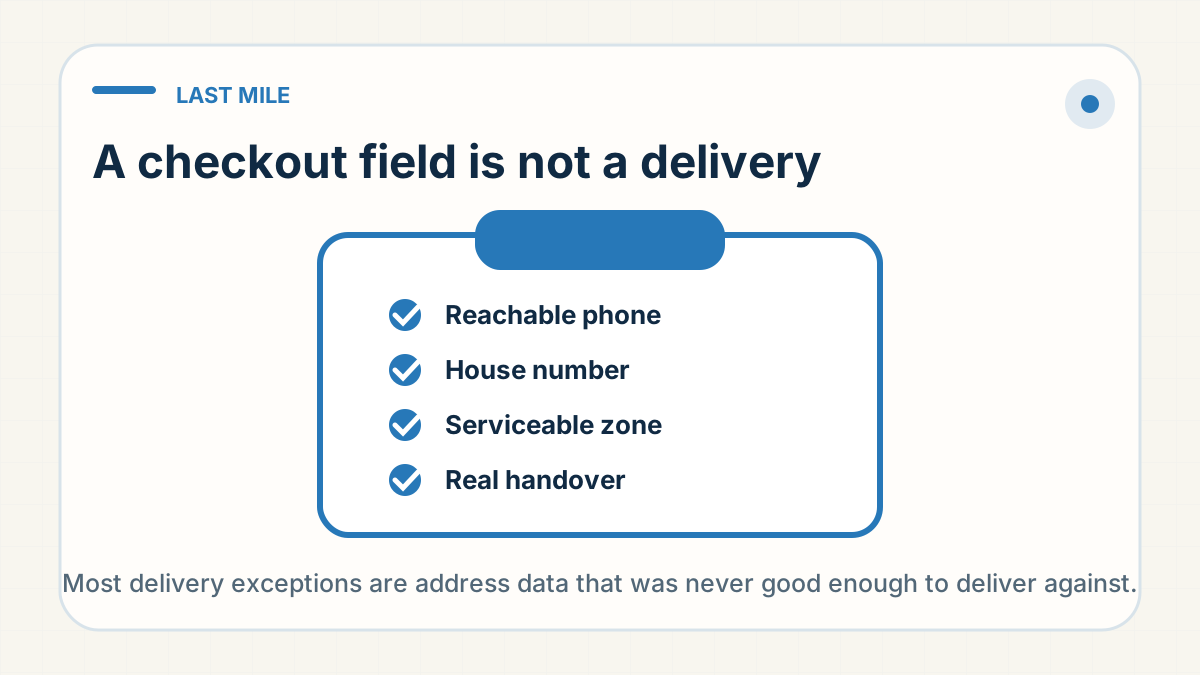
Collect a reachable telephone number and a complete street address at checkout, and check destination coverage before you advertise there. Addresses dominated Friday. Orders to one European market could not move at all without a recipient telephone number. Others were missing a house or unit number and had been sitting undispatched. Several destinations had no serviceable route regardless of what the checkout accepted. And a handful of parcels marked delivered had not reached the person expecting them.
- 01Require a reachable phoneSome networks will not create a label without one.
- 02Require a complete street numberA mapping service will happily omit what a courier needs.
- 03Confirm the zone is serviceableIslands, forces and box addresses may have no route at all.
- 04Verify handover, not the scanCheck neighbour, reception and safe place before deciding.
A checkout field is not a delivery instrument
A store can accept an address that no carrier can use. Some networks treat a telephone number as mandatory and will not create a label without it; some require a street number that a mapping service will happily omit; some rely on a name matching a doorbell or mailbox rather than a unit number, which works locally and fails when the data is entered from another country. None of this is visible at checkout, so it lands later, as a stalled order or a failed attempt.
Some addresses are simply out of network
Island and offshore destinations, forces addresses and post-office boxes came up repeatedly. The right answer is not to attempt them and hope. It is to say early that the destination is outside the available network, and to offer the seller the real choices: a mainland alternative, a postal option with different cost, speed and compensation terms, or a refund. Attempting an undeliverable address quietly converts a refund conversation into a lost-parcel conversation.
Delivered is a scan, not a handover
One case had a proof-of-delivery photograph showing an address that was not the customer's. Another had a valid delivery certificate and a customer who had genuinely not received anything. A delivery scan is strong evidence and it is not proof, so the useful sequence is to obtain the last-mile reference and any photograph, check whether the parcel was left with a neighbour, reception or safe place, and only then decide between recovery, reship and refund. Where a parcel is held for collection there is also a deadline behind it, and missing that deadline can end in return or disposal — which is a much worse outcome than a redelivery fee.
There is an uncomfortable limit here that is better said than skirted. Where a carrier has marked a parcel delivered and can produce proof, it will generally decline both a free reshipment and a refund, and no amount of escalation changes that. At that point the loss is real and the only question is who absorbs it. Pretending an investigation is still live, when it is functionally closed, wastes the seller's time and delays the decision they actually have to make with their own customer.
Hand over the last-mile reference, not just the main number
Several sellers asked for something small that makes a large difference: the local carrier's own tracking number, not only the through-service reference. A customer chasing a parcel in their own country needs the number their local carrier recognises; the origin number is frequently meaningless on a domestic tracking page and produces a support ticket rather than an answer.
One seller made the point in the most practical form — give me the reference every time, even before final delivery, because the time difference means I am handling my customers while you are asleep. That is a fair request and cheap to honour. The generalisable rule is that any handoff reference the customer might need should be pushed to the seller proactively, not held until asked.
Uncollected is a deadline, not a state
A steady share of the week's exceptions were parcels sitting at a pickup point or awaiting a failed-delivery response, each with a date behind it after which the parcel returns overseas or is destroyed. Those dates are the most actionable information in the whole queue and the easiest to lose in a chat thread.
The workable habit is to treat every held parcel as an open action with an expiry rather than as a status. The seller has to reach their customer inside that window, and the customer usually has to contact the local carrier themselves — which they will only do if someone tells them exactly who to contact and by when.
New seller desk
Friday's newer conversations covered accessories, apparel and home goods, with US, UK and European route questions and scale from first orders to low tens. Address quality is one of the few operational subjects worth raising with a seller before their first live order, because it is fixed cheaply at checkout and expensively at the destination.
Treat contact data as part of the route
Collect a reachable telephone number and a complete street address at checkout, and check destination coverage before you advertise into it. Most delivery exceptions are not carrier failures; they are data that was never good enough to deliver against.