From the operations desk
The situation
The Saturday review brought together early conversations and older threads that were not ready to move. Some sellers were still exploring a product and market with no orders. Others remained interested but needed time to resolve an internal business matter. Neither situation benefited from being described as further along than it was.
Running underneath that, the day carried a lot of ordinary quoting, sampling and packing work. What connected it was the same discipline the relationship threads needed: being accurate about what was known, what was still an assumption, and what would have to be measured before anyone could rely on it.
- 01Fix what is already firmTooling, decoration and lead time can be settled early.
- 02Label the estimate and whySay which number moves, and what it is waiting on.
- 03Pack and measure a samplePacked dimensions and weight are what the route actually charges.
- 04Convert to a firm quoteOne named event turns the estimate into a number to price against.
A preliminary price is not a quotation
Two separate custom-product conversations landed on the same honest answer. A price can be given before a sample exists, but it is an estimate, and it should be labelled as one. Until a physical unit has been produced and packed, nobody knows the packed dimensions or weight — and on cross-border routes those are what actually set the shipping figure. A tooling or setup charge, a per-unit decoration charge and a production lead time can be firm long before the delivered cost is.
The same limit applies to protective packing. One fragile-goods enquiry needed custom moulded inserts with a several-hundred-set minimum, and the useful reply was that the insert cost and the freight cost could only be worked out after a sample had been packed and measured. Guessing would have produced a lower number and a worse outcome, because the correction would arrive after the seller had already priced their product page.
The practical form of this is a quotation with three labelled parts: what is fixed now, what is an estimate and why, and the specific event that converts the estimate into a firm number. A seller can plan against that. They cannot plan against a single figure that quietly changes later.
Check that a bundle physically fits before you sell it
A seller running a gift-with-purchase offer expected the free item to travel inside the main product's existing box. From previous consignments we knew that box had almost no spare room. Rather than assume it would work, the answer was to inspect the actual space on arrival, unit by unit, and to split the order into two parcels where the gift would not fit.
That matters commercially, not just operationally. A bundle that needs two parcels costs more to ship, can clear customs as two consignments, and arrives in two deliveries — which is a different customer experience from the one the offer implied. The measurement is cheap; discovering it at dispatch on a live promotion is not.
What a first payment actually needs
Two first-payment conversations stalled on documentation rather than on price. One seller could not release a bank transfer until an accounts function had an invoice showing full company and tax details in a durable format. Another needed the payment route itself confirmed, because only certain methods and currencies are accepted and a payment sent the wrong way has to be returned rather than applied.
Neither is a difficult request, and both are much easier to answer before a first order than during one. A short setup note covering the accepted payment routes, the currency, the invoice format and who the invoice is addressed to removes a class of delay that has nothing to do with sourcing.
Name the commercial stage
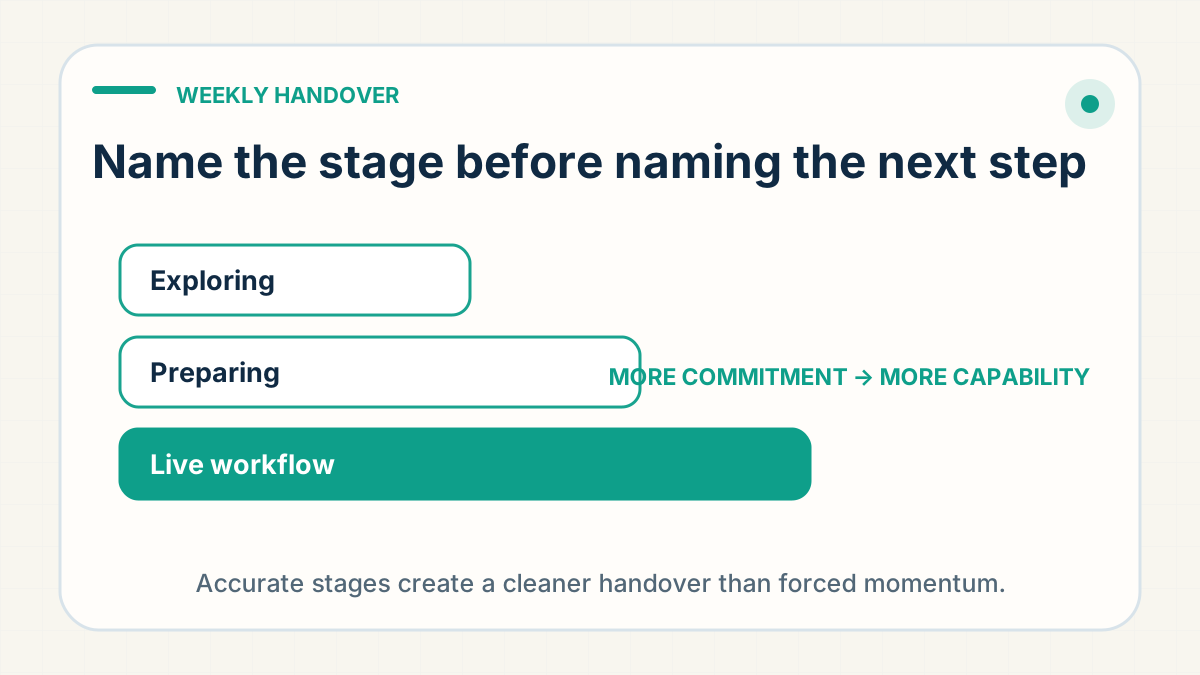
An introduction, enquiry, scheduled call, quote, sample, first payment and live repeat-order workflow are different milestones. Naming the current stage prevents forecasts from becoming stock commitments and prevents a polite expression of interest from being recorded as an operational handover. It also helps the team ask the right next question.
Leave room for an honest pause
A useful follow-up does not force momentum where a seller is not ready. It records what has been discussed, what still needs confirmation and what event would justify reopening the work. For a new enquiry, that may be a clearer product brief or first test. For a paused project, it may simply be the seller confirming that their internal dependency has been resolved.
What the intake register showed
The week contained dozens of likely new-seller conversations, but the Saturday record did not support claiming a fresh wave of confirmed clients. Many threads were still enquiries, quotation work or sample decisions; a smaller subset had reached concrete onboarding actions, and fewer still could be described as live. That stage-by-stage view is more commercially useful than one inflated total because it shows which next action can genuinely move each conversation forward.
The rounded scale context told the same story: the register ranged from sellers with no orders or a first test to conversations in the low tens of orders. The market was not consistently stated on Saturday, so the review did not invent one. Honest absence is part of useful operational reporting too.
End the week with states, not optimism
Good operations reporting should make uncertainty smaller, not hide it. That applies to prices and parcels as much as to relationships: an estimate labelled as an estimate is useful, a bundle measured before it is sold is cheap, and a payment route agreed before the first order removes a delay that has nothing to do with sourcing. Ending the week with accurate stages and owned next actions gives the next week a clean starting point—and gives sellers space to make a real decision instead of performing progress.