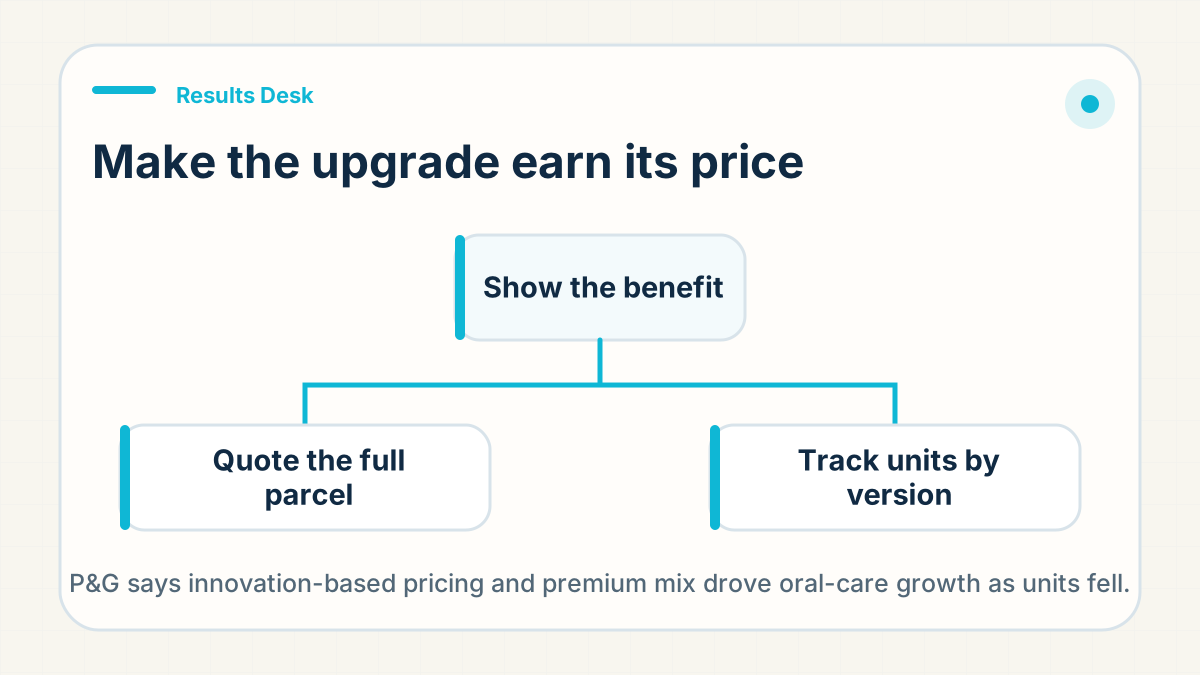
P&G says innovation-based pricing and premium mix drove its oral-care growth while unit volume fell. In its release dated October 22, 2026, Oral Care organic sales grew in the low single digits for July–September 2026. The company calls the unit decline a partial offset to growth. Our view: lead a new oral-care offer with a benefit a shopper can see. A plain generic puts you in a price contest with sellers that have scale. Keep the plain version live too: shoppers trading down may prefer it. Make the upgrade earn its premium before increasing inventory.
How should a beginner choose a product worth testing?
Choose a product with a clear reason for its price. P&G calls its unit volume decline an offset to growth. Our read: some of its lost units likely went to cheaper alternatives, because the release pairs higher pricing with fewer units without saying where those units went. P&G earns its premium with established brands and its own innovation. A small seller cannot count on that brand power or those resources. Your reason for a premium must be a benefit a shopper can see.
That gives you a concrete sourcing choice. Put a plain version beside an upgraded version of the same proposed item. Ask what the customer gains from the change. A better grip, a more useful travel case or a clearly specified replacement attachment are examples to investigate, not features established by this release. Ask for samples that let you demonstrate the difference. If the upgrade cannot be shown in a short product demonstration, we would keep the simpler offer.
The commercial view is straightforward: a visible improvement gives you something to price; an unexplained premium gives the customer a reason to leave. Keep the entry product credible and make the upgrade optional. That lets a customer choose the benefit without forcing every order into a more expensive pack. You can start this comparison before launch, using a sample, a supplier quote and your proposed customer page.
Is the listing you sent the same product as the one I am selling?
Make the improved version reproducible before paying to promote it. Your price needs to match a difference the customer receives, from the listing to the delivered parcel. A feature that exists only in a photo gives you no reliable basis for a higher price.
Write the version into the quote: materials, dimensions, included attachments, pack contents and packaging. Ask the supplier to identify any difference between the catalogue picture and the sample. Approve the actual sample you intend to offer. Keep its photographs beside the written specification, so the next batch can be checked against a concrete reference.
Price the upgrade as a complete parcel. A travel case that changes the packed size needs a revised shipping quote. An extra attachment needs clear packing instructions. A feature that brings extra assembly or replacement work needs that work priced too. These are questions for your own product and route; the issuer's release supplies no parcel-cost saving.
Whitening, gum-health and similar benefit claims can be regulated in the destination market. Describe what the product visibly does and check any health claim. Whitening upgrades can also face formula limits, such as hydrogen peroxide strength, so check the destination market's rules before sourcing a stronger formula. If your powered-brush upgrade uses a lithium battery, carrier eligibility and packing change too; size alone cannot price the shipment. Budget opened oral-care returns as write-offs, because you cannot assume they are fit for resale.
You can forward this sentence: "Please quote the approved version and the upgraded version separately, list every difference in the product and packed parcel, and confirm that substitutions need my written approval." That request turns a vague premium idea into a comparison you can use. It also makes a lower quote easier to interpret: you can see whether the price changed because the offer changed.
How can I improve margin without weakening the offer?
Negotiate the cost of a defined offer, then decide whether the upgrade deserves its place. A cheaper quote is useful when the sample, pack contents and service promise remain clear. Cutting the feature behind your selling message simply leaves you with a more expensive claim attached to a weaker product.
Protect the customer benefit before the premium label. A visible difference gives you a reason to charge more; the full costs decide whether that price works. For your store, compare what the customer pays with product cost, packing, delivery and expected after-sales expense. Use confirmed terms. Ask for the missing quote line before treating the remaining amount as profit.
Keep a plain entry offer if it works on those terms. Let the upgraded offer earn a higher price through a benefit you can show. Avoid hiding a weak entry product behind a bundle that customers must take. That is a product and pricing choice you control, even when you have no power over a large brand's pricing or marketing budget.
Where is my profit supposed to come from if the landed cost is close to my selling price?
An existing product with repeat paid demand can justify a different decision from a new premium test. A straightforward replacement item might solve a customer need without extra features. If your unchanged offer already attracts repeat orders and leaves enough after full costs, keep replenishing from that evidence. P&G's category unit trend is not your supplier's order trend, and its oral-care growth is not your order forecast. Its pricing and mix are not your achievable price premium.
The unresolved issue in a new offer is whether customers accept the added price for the added benefit. The release does not size that relationship for your product. Compare your own versions at clearly displayed prices. Keep the basic version available while you learn. A sample approval answers a product question; paid demand and the costs attached to those orders answer the commercial question.
Set the test budget and stop point before launch; with low traffic, read both versions over enough paid orders to see whether each repeatedly earns money after refunds and parcel costs before deciding.
For an active store, put paid units beside money collected for each unchanged version and pack size. Keep cancellations, refunds and discounts on a consistent basis. A higher total with flat or falling units tells you to inspect the basket before raising the next supplier order. Rising units for the same offer give you stronger grounds to discuss replenishment. Track a new upgraded version separately so its launch does not obscure demand for the original.
This is a reading of P&G's operating disclosures for sellers sourcing and shipping goods. It is not a view on P&G as an investment, and it is not legal, tax or investment advice. The release covers the company's fiscal first quarter, with the July–September window stated above. Its publication date is not the date demand changed in your store. Keep broader company growth drivers you cannot copy separate from the sample, quote and order history you can check.
How should I size my next order after testing both versions?
Set your next supplier order from paid demand for each exact version. Use your own order history to decide what to replenish. Keep the product version, the customer price and the parcel instructions together, so a repeat order delivers the offer that earned it.
- Tester: compare the plain and upgraded samples. Choose the benefit you can demonstrate, obtain the full parcel quote and write the customer page around that exact version.
- Early scaler: separate paid units by version and pack size. Keep the upgrade test visible in your records, and size replenishment from the demand already attached to each offer.
- Established winner: protect the specification customers recognise. Confirm whether the next supplier quote changes a component, attachment or pack before treating it as a saving.
- Brand-or-hybrid-scaler: make the paid benefit explicit. Check that the supplier can reproduce it, the product page explains it and the packed parcel delivers it without an unexplained substitution.
Before increasing inventory, use the questions in prepping your fulfilment partner before a viral moment to settle repeat packing and replenishment instructions. Keep the approved sample and the confirmed quote in the same handover. That gives the person receiving the goods a reference for the version you priced.
- Watch: paid units for each unchanged offer, customer acceptance of the upgrade, actual parcel costs and whether the delivered version matches the approved sample.
- Reject: an upgrade whose benefit you cannot demonstrate, a cheaper quote with unexplained substitutions, or a larger batch justified only by another company's sales growth.
Our call: lead a new oral-care offer with the benefit you can demonstrate, then make it earn its price. Keep the plain version live for shoppers who may be trading down and replenish each version from its own paid demand. Make the product earn the next order.
Need a product checked before you spend on ads?
Send us the product link and destination on WhatsApp (+86 178 4666 9989). We will help you assess sourcing, packing and shipping before you commit.
Get Sourcing Quote on WhatsApp →