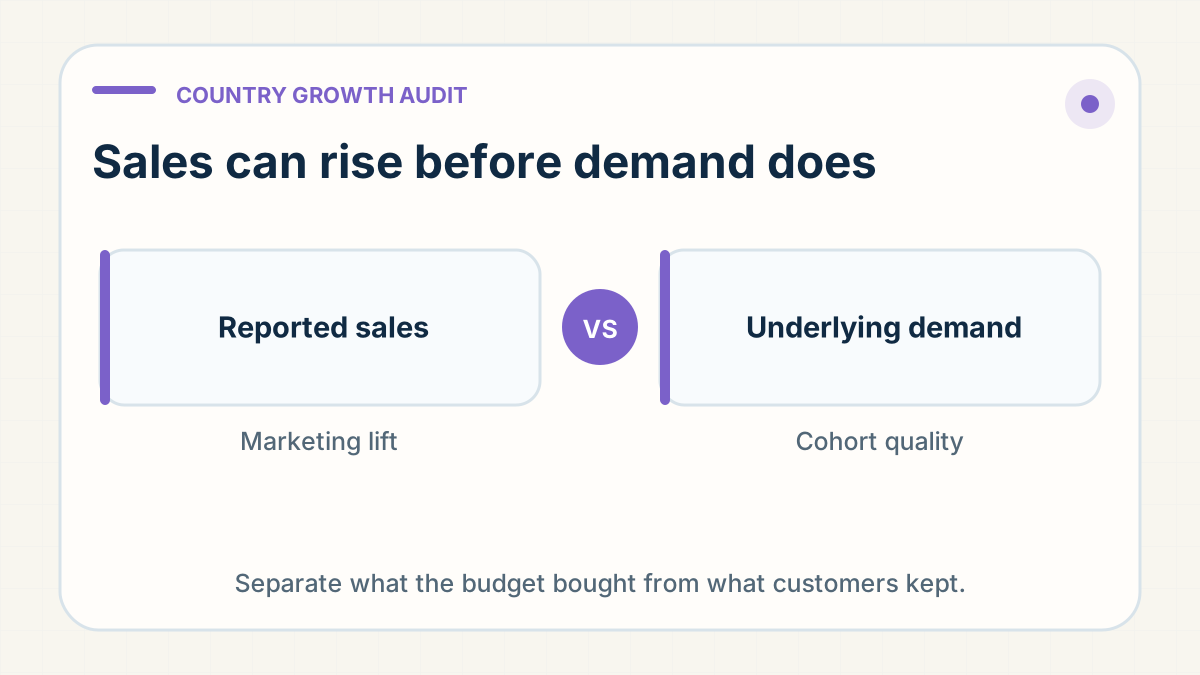
Separate the budget from the demand
You need two answers before you call a country a winner: did more people want the product, and did you buy more sales with ads? A country sales number cannot tell you. Sales can rise after you spend more, change the price, add a marketplace or catch a short-lived rush. Write down what changed. Then compare the people who bought this month with the people who bought before.
You can start with a country profit stack that puts your product, price, payment, route, refunds and traffic source in one place. From there, ask the useful question: did your new customers become good customers, or did the budget only make the sales line louder?
A company result shows why the question matters
NEXT reported international direct-to-consumer full-price sales up 24% in the six months to 25 July 2026. It estimated that marketing activity explained 23 percentage points of that 24% increase, leaving roughly 1% of underlying growth using its own way of counting. Marketing expenditure rose from £31 million to £51 million, while extra cash profit before marketing and fixed costs was £1.77 per £1 of sales against £1.75 in the prior year.
Those figures come from NEXT's official 2026 half-year results, pages 9–11. They describe NEXT's full-price direct-to-consumer international business and its definitions; direct-to-consumer excludes aggregators. They are not a dropshipping benchmark, a forecast for your store or evidence that paid growth is bad. They are a clean reminder to ask what a reported growth number contains.
The same filing carries a second warning. NEXT says the oldest international customer groups were recruited when marketing spend was lower, so newer paid groups may not behave like older ones. Its 2022 group retained 33% of international customers after one year and 17% after four years, compared with 35% and 19% in the UK. Those retention rates use NEXT's definitions and cannot be transferred to your store. The decision lesson can transfer: new-customer quality can change while the headline market keeps growing.
Its August 2026 trading statement also described overseas outperformance alongside pent-up demand and more profitable marketing spend. Management explanations are useful context, not a causal test. Keep the explanation beside the result and keep your own test separate.
Three things can make a country sales line rise
Use three buckets before you use the word demand. The buckets can coexist, and one does not cancel the others.
- Underlying customer demand: more of the right customers want the same product or job at a comparable price and promise, without needing a proportionally larger acquisition push.
- Paid acquisition: more spend, more impressions, a new channel, a new audience or a stronger creative buys more first orders. That can be good growth, but it needs its own payback and new-customer check.
- Temporary or definitional effects: a low comparison base, a promotion, a price change, a new marketplace, a currency movement, pent-up demand or a change in what the company counts.
Do not force the whole increase into one bucket. A new country can have real demand and still become less attractive when the next customers cost more to acquire or return less often. The operational question is what remains after the temporary lift and the extra acquisition cost are visible.
Build a country growth bridge
For each country, keep one bridge from the previous comparable period to the current one. It does not need to produce a perfect split. Its job is to stop a blended growth number from approving the next spend.
- Reported sales: the exact revenue basis, period, currency and comparison.
- Price and mix: price changes, discounts, bundles, premium variants and product mix.
- Acquisition: spend, channel, audience, creative family and the number of first-time customers bought.
- Existing-customer activity: repeat orders, email or other owned traffic, and whether the country had a different customer base before the test.
- Temporary effects: launch timing, season, stock availability, platform change, marketplace addition or one-off event.
- What is still unknown: any driver the data cannot size. Unknown is not zero.
Keep the original numbers beside the percentages. A country that grew 24% from a very small base, after a major ad expansion, answers a different question from a country that grew 24% with stable spend and a long-standing customer base. The rate alone cannot tell you which one you have.
If a company result is the reason you started looking, use the growth-driver record before you source from it. The same habit applies to your country dashboard: name what the number includes, size what you can and mark the rest as an evidence gap.
Ask what happens when the budget stops rising
The most useful counterfactual is simple: if the next country month receives the same acquisition budget rather than a larger one, what would your store still expect to earn? You cannot answer that by looking at total sales. Compare customer groups by when they were acquired and how they arrived.
Use acquisition month by paid or non-paid source, then keep your product version, price, offer, delivery promise and refund rule visible. A new paid group is not automatically worse. It is simply a different population that needs its own first-order costs and a fixed outcome window.
Watch for a common false comfort: the country is growing, but each new month contains more recently acquired customers and fewer repeat customers who have stayed. The sales line rises because the funnel is being fed faster. That can be a sensible investment if those new customers later pay back. It is a warning if the next spend is required just to replace customers who never return.
Run one country customer test
Choose one expanding country, one product family or hero SKU and four consecutive acquisition weeks. Do not start with every product and every market. The smaller test makes it possible to keep the product, promise and route close enough to compare.
- Before week 1, define a valid newly acquired customer, the paid and non-paid source rules, the product or family, the country, the currency basis and your profit-after-costs formula.
- During each week, record first-time customers, valid paid orders, acquisition spend, refunds, reships, chargebacks and the exact fulfilment or route setup.
- After the fixed outcome window, join each group to delivery and commercial outcomes. Do not call a recent group settled just because its first order was paid.
- Keep the first-order CAC and 30-day second-purchase rate as separate diagnostics. Do not let a repeat rate hide weak profit after first-order costs, and do not treat a first order as a failure before its promised outcome window ends.
Use delivered profit after costs, once refunds and reships have settled, per valid newly acquired customer as the primary business measure. Keep revenue, first-order CAC, 30-day second purchase and delivery or refund exceptions beside it. The counting basis matters: profit after costs per customer and profit after costs per £1 or US$1 of spend answer different questions.
A four-week acquisition period plus a 30-day read is a practical starting frame, not a universal rule. Extend the outcome window when your route, refund or reship pattern takes longer. If the final group has not reached the same window as the first, label its result provisional rather than blending it into the average.
Do not scale from a short list of customers just because every outcome is settled. Set a minimum customer count or a simple uncertainty rule before you start. If one rare refund, reship or chargeback could erase the profit, run a stress case with that loss. Until your count clears the rule, hold or gather more orders.
Do not mistake this for a causal experiment
The customer test is an audit and a scaling decision, not proof that advertising caused every order. Seasonality, price, creative, competitor activity, stock position and another channel can move at the same time. If you need a causal answer about extra demand, use a properly designed holdout or geo experiment with a credible comparison.
The test still earns its place because it prevents a simpler mistake. It can show that a better-looking country result is accompanied by lower paid orders per unit of spend, weaker settled profit after costs or more delivery and refund problems. You do not need a perfect causal model to refuse to scale a group whose settled numbers do not work.
Keep the country test attached to the parcel
A country can look attractive before the product reaches the customer. Keep the product version, packed dimensions, payment method, displayed delivery promise, route, customer-ready cost, refunds and replacements with each customer group. Otherwise a country result can improve because a different product, bundle or route entered the mix.
- A new price can lift revenue while reducing units or changing who buys.
- A new route can improve delivery while adding cost or a different customs and returns outcome.
- A bundle can improve first-order sales while increasing packing work, chargeable weight or replacement exposure.
- A new product version can create the sales lift while the original version would not have passed the same test.
The country does not own the result by itself. The result belongs to a product, version, offer, traffic source, route and customer promise. Change one of those materially and start a new comparison or record the break clearly.
Make the decision by evidence, not by the headline
- Scale carefully when the newer paid group still produces acceptable profit after costs have settled, with complete customer-ready and acquisition costs counted, and the route and customer outcomes remain workable.
- Hold when the country is growing but the newest group is still inside the outcome window, the source mix changed or the growth bridge has an important unknown.
- Reduce or redesign when extra spend buys sales but settled profit after costs, repeat behavior, delivery result or support burden moves the wrong way.
- Stop the country test when the product, route or customer promise cannot be supported, even if reported sales continue to rise.
These are decision states, not universal performance thresholds. Set the commercial floor, outcome window and stop rule before the next spend. A high-growth country that has not cleared its own settling window is not yet a proven country.
Where RyanFulfil fits
RyanFulfil can help keep the China-side facts attached to the test: the exact supplier version, sample or specification, customer-ready packed cost, route options, dispatch evidence, stock state and the evidence behind a refund, replacement or reship. That makes a country customer group easier to reconcile with the physical order that followed it.
You remain responsible for demand, pricing, advertising, payment setup, tax and legal advice, the customer promise, the commercial floor and the decision to scale. RyanFulfil cannot guarantee a country's conversion, delivery time, customs outcome, repeat rate or profit.
Bring the product version, target country, traffic source, promised delivery window, expected quantity and decision rule. Contact RyanFulfil when the question is whether the China-side product, packing and route can support the market you are testing.
What this does not prove
Last verified 18 September 2026. NEXT's figures are company-reported international direct-to-consumer full-price sales, marketing activity, marketing expenditure, extra cash profit and retention under NEXT's definitions. The estimate that marketing activity explained 23 percentage points of 24% growth, and the implied roughly 1% underlying growth, are a reading of the company's bridge rather than a universal split. The customer test, decision states and country growth bridge are RyanFulfil's editorial operating proposals, not company standards or guarantees.
Recheck the source and your own customer groups after a material change to spend, price, product mix, route, payment, currency, tax, refund policy, fulfilment setup or customer promise. A new country earns more budget only when its latest comparable customer group earns that decision after the outcome window has finished.
Need a product checked before you spend on ads?
Send us the product link and destination on WhatsApp (+86 178 4666 9989). We will help you assess sourcing, packing and shipping before you commit.
Get Sourcing Quote on WhatsApp →