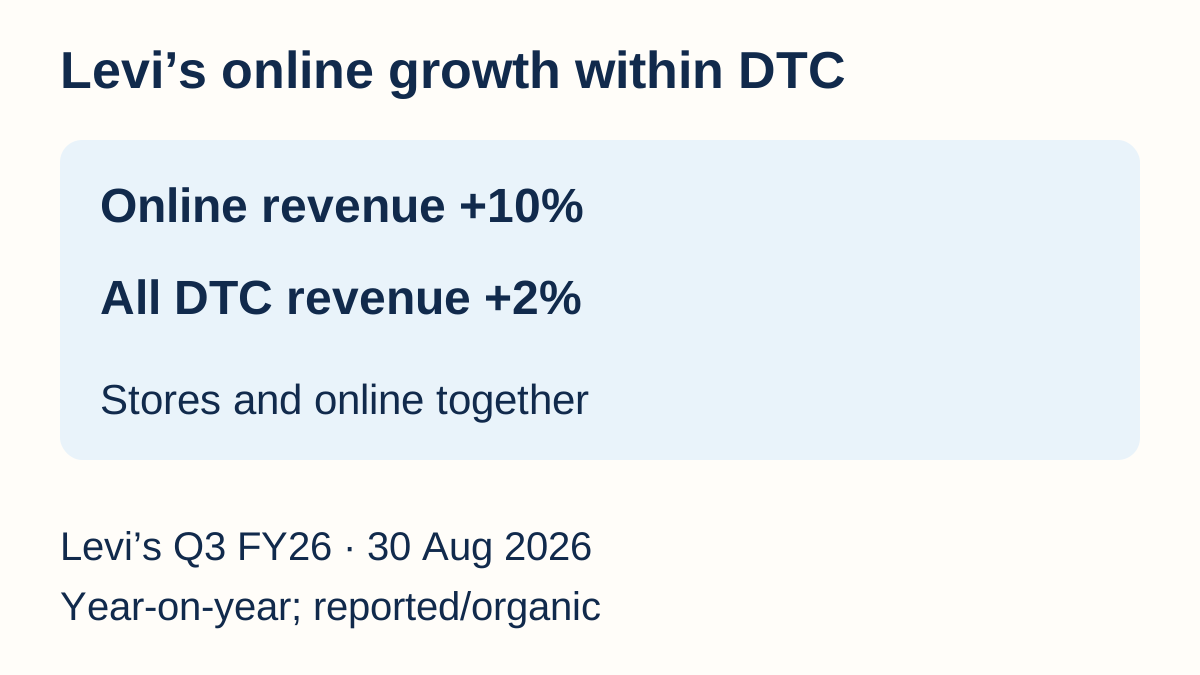
Levi Strauss's online revenue grew 10% in the quarter ended 30 August 2026. Its direct-to-consumer revenue, or DTC, grew 2%. Wholesale revenue grew 6%. Each rate compares with the quarter ended 31 August 2025, and each is the same on reported and organic bases. DTC covers the company's own stores and online business. Online is part of the direct total, so these figures describe a fast-growing piece inside a slower-growing whole. If you read them as separate businesses, you lose that relationship.
The company said DTC fell short of its internal expectations. Its filing points to softer store traffic in the Americas and Europe. Asia had a different story, with store performance and expansion adding to online growth. Our reading: the useful question is how those store results differ, rather than whether online growth means physical stores are failing everywhere. You can see the channel split, but you cannot put a precise dollar value on each cause. Levi's 10% online growth is not a forecast or benchmark for your store.
Online growth sits inside the direct total
Ecommerce grew 10% and total DTC grew 2%. The online business grew faster than the combined channel. Management says weaker store performance partly offset ecommerce growth and store expansion. That helps explain the modest total without telling us exactly how much each part added. This is what sits inside a growth number: a weighted mix of faster and slower pieces. You cannot infer dollars from those two rates alone. The release gives no quarter-only ecommerce revenue base, so you cannot slice the 2% into an online dollar amount and a store dollar amount.
The filing explains the pattern in management's words. In the Americas, DTC growth from ecommerce and store expansion was largely offset by slower traffic in company-owned stores. In Europe, DTC decreased mainly because weaker store performance from softer traffic. At the aggregate level, DTC growth came primarily from company ecommerce and expansion, partially offset by softer traffic. Those are management's explanations; the reported rates do not independently establish causes. Management attributes some growth to ecommerce and expansion, and that attribution is useful context. Its magnitude remains unquantified. Your own shipping and sourcing decisions need your own data, not a borrowed contribution estimate.
The comparable measure includes digital
The 0.4% comparable sales growth is a defined measure: existing Levi's brand company-owned mainline and outlet stores open at least twelve full fiscal months, plus owned digital channels. It uses constant currency and excludes portfolio and comparability changes such as material relocations, expansions, and remodels. That is why it is not store-only and has a different scope from all DTC. The all-DTC figure includes additional brands and new stores. If you run a small store, the 0.4% is not a small-store benchmark; it is a company-defined base. The prior-year comparable growth was high single digits, so the current 0.4% is slower against that base.
The constant-currency base matters for the comparable rate. The three headline rates are the same on reported and organic bases, so for those three, organic does not change the number. The comparable rate uses its own defined constant-currency scope. You should not swap those bases or assume one applies to the other. A softer comparable reading can sit beside online growth because online is inside the comparable base, stores are inside it, and the mix can pull the combined rate toward the slower piece. These channel disclosures do not quantify a store-only growth rate, customer migration, online conversion or spending per purchase, or profit by channel. Those gaps limit the story you can tell from the outside.
Asia's stores tell a different story
The regional detail prevents a blanket "stores failed" reading. In Asia, DTC grew on store performance and expansion plus ecommerce growth driven by higher demand. That is different from the Americas, where softer company-owned store traffic offset ecommerce and expansion, and from Europe, where weaker store performance from softer traffic reduced DTC. Asia store performance is a concrete counterexample: it shows not every region's stores moved the same way. It does not say every Asia store grew, only that the regional store performance contributed positively in management's explanation. If you operate in more than one market, that regional split is more useful than a single global label.
Wholesale grew 6%, faster than total DTC. Wholesale revenue is what Levi's receives from retail partners, not those partners' sales to end customers. The filing does not translate that 6% into retail partners' sales to end customers or your own demand. For a reader who sources and ships goods, the practical distinction is between a brand's own-channel growth and partner-channel revenue. They answer different questions. The company's own explanation links DTC growth to ecommerce and expansion, with traffic a partial offset. The scale of each piece is not disclosed, so you should treat the regional pattern as directional, not as a precise dollar map.
The date attached to revenue matters
Levi Strauss changed ecommerce revenue recognition at the start of fiscal 2026 from delivery to shipment. The issuer says the impact on the consolidated statements was not material, and it provides no separately quantified ecommerce effect. That timing shift relates to the date attached to the sale, and it is a reminder that order, shipment, and delivery dates can fall in different reporting periods. It is not a proven growth driver in these numbers. When you compare periods, your own revenue cutoffs and shipping terms can create the same kind of timing difference. The disclosure gives you a reason to check timing, not a reason to attribute Levi's 10% to an accounting change.
The release and filing give channel rates, a comparable measure, and management explanations. They do not give a quarterly ecommerce revenue base or quantify how customers moved between channels and how profitable those channels were. They also do not establish that faster online growth caused slower store traffic, that customers migrated, or that online was more profitable. Levi's 2% total DTC growth and 6% wholesale growth are not forecasts or benchmarks for your store. Its comparable measure also describes its own qualifying stores and digital channels. Your channel mix, traffic, and margins are separate. Use the company facts for context, then apply your own operating data to your own sourcing and shipping choices.
Read other company operating stories
Our reading: the quarter shows online growth alongside softer store traffic in the Americas and Europe. Asia's store performance is the counterevidence. Management attributes some DTC growth to ecommerce and expansion, and the magnitude of that contribution is unquantified. This read of Levi Strauss's operating disclosures is for sellers sourcing and shipping goods. It gives no view on the company as an investment and is not legal, tax or investment advice.
The next useful company question is whether existing store performance strengthens alongside online growth. More detail on traffic, purchasing and each channel's revenue would distinguish recovery in the existing business from growth through new locations. For now, the regional explanations establish a mixed picture rather than a uniform retreat from stores.
Need a product checked before you spend on ads?
Send us the product link and destination on WhatsApp (+86 178 4666 9989). We will help you assess sourcing, packing and shipping before you commit.
Get Sourcing Quote on WhatsApp →