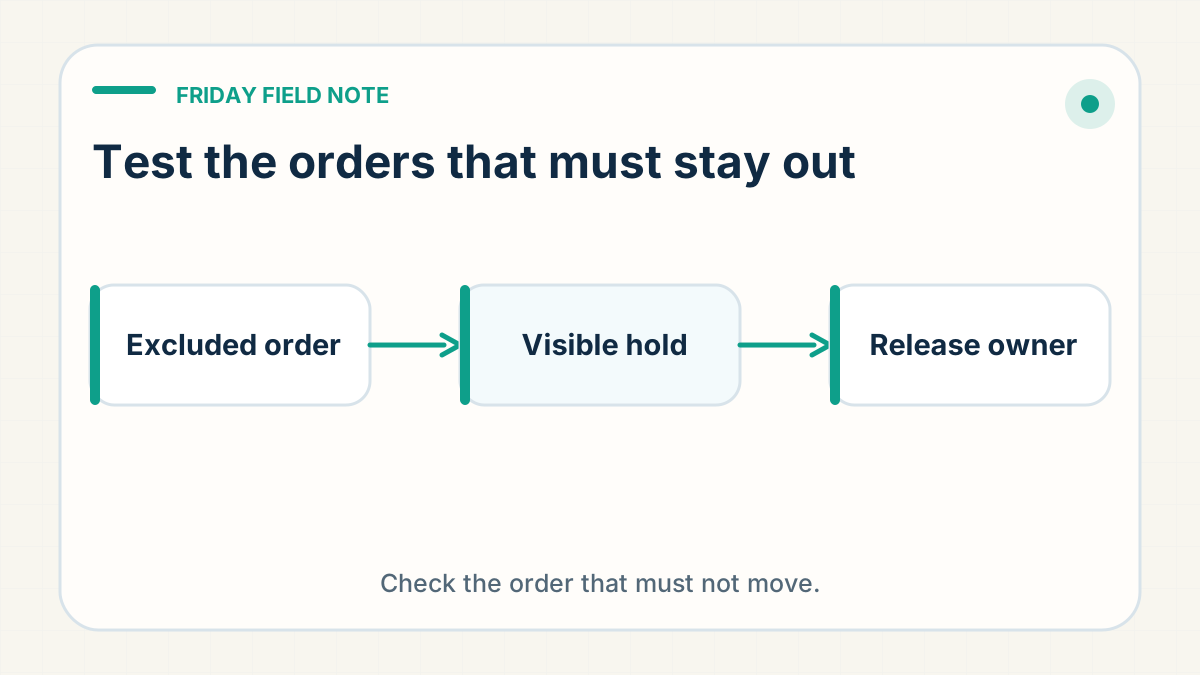
Field note
A connected store needs a test for the orders you do not want fulfilled. One seller questioned why a partly paid order had shipped while it was suspended. Another asked the team to leave an existing order alone because it had already been handled elsewhere. Our store connection guide covers the first live order; add an exclusion test before you rely on the connection.
Start with an order that must not move
Write down three cases that should stay out of purchasing and release. A test order, an order already handled elsewhere and an order awaiting full payment need different reasons, even if your instruction for each starts with "do not buy".
Choose a safe test with your fulfilment team. Show them the order in the store and ask them to show the same order in their receiving view. The expected result is no purchase and no release until you give the agreed instruction. Do not rely on a successful ordinary order to prove that an excluded one will stop.
Check what the receiving view can see
A hold only helps if the person receiving the order can recognise it. In one case the team said the hold did not appear on the order they received. The seller had described it as suspended and partly paid. The next day, the team said their order view did not show partial payment.
That does not tell you what your own connection can see. Ask the team to check the payment and hold states you use. If a state does not appear, agree how you will flag the order outside that view. Name the person who can hold it and the person who can release it after the condition changes.
Keep a test separate from a live purchase
A test order can appear in the same queue as a customer order. Tell the team which one is a test before anyone uses it to buy stock. In another conversation, a seller identified an order as a test and the team later confirmed that it would not buy or ship it.
An order sent to another provider needs its own exclusion too. Give the team the order reference privately and tell them where their responsibility starts. For a switch between providers, check the last order handled by the old provider and the first order the new team may process.
Agree the release instruction
Before the next import, obtain the exact instruction that changes an order from held to ready. Write down who sends it and where the receiving team will see it. If the status cannot travel through the connection, agree a manual hold and a named owner. Use the platform fulfilment preflight to check the rest of the journey around that decision.