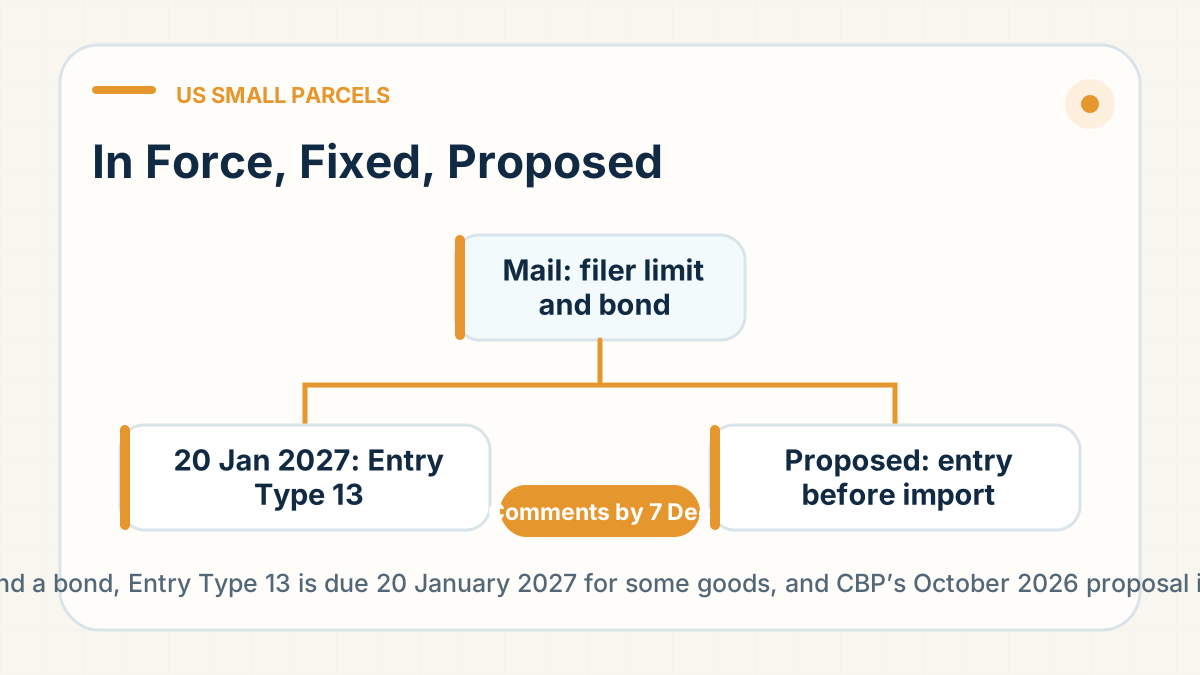
If your US customers get parcels by post, a filer limit and a bond already apply to US mail informal entry. On 14 October 2026, U.S. Customs and Border Protection (CBP) said Entry Type 13 becomes mandatory on 20 January 2027 for the informal entry of postal shipments subject to Section 201, 232 or 301 duties or to another agency's rules; otherwise formal entry is required. That date does not wait for CBP's separate proposal of 8 October 2026, which covers shipments of $2,500 or less and is open for comment until 7 December 2026. This page keeps three layers apart: in force now, fixed for January, proposed only. It is not customs advice.
What already applies to my US parcels sent by post?
Since 24 July 2026, CBP's FAQ says, US mail entered under the mail informal entry process has a filer limit and a bond. Only an owner or purchaser of the goods can make entry, or a licensed customs broker whom the owner, purchaser or consignee has designated. The filer must also have a basic importation and entry bond, either single transaction or continuous.
The filer emails a worksheet to CBP by the 7th day of the month after the parcel arrives. Duty is paid through Pay.gov by the same day. If the filer has no bond or no right to make entry, CBP holds the shipment until a filer submits the entry and the bond.
Ask your postal line, carrier or broker who files and who is the importer of record on your parcels today.
Which mail parcels need Entry Type 13 or formal entry from 20 January 2027?
From 20 January 2027, says CBP's release of 14 October 2026, postal shipments subject to Section 201, 232 or 301 duties, or to the jurisdiction of another agency, must use Entry Type 13 for informal entry, "otherwise, formal entry is required". It moved the mandatory date for Entry Type 13 from 22 October 2026. It adds: "There are no changes to international mail entry procedures before Jan. 20, 2027."
The release ties this to CBP's 24 June 2026 interim final rule, not to the 8 October proposal.
CBP's FAQ, last modified 6 November 2026, lists a wider set of goods that cannot use the worksheet route. It names Chapter 98 duty-free claims, goods subject to Chapter 98 or 99 duties, free trade agreement claims and goods under another agency's rules. The FAQ still shows 22 October 2026. The two documents differ, so ask your filer which applies to your goods.
This page does not say that any product is subject to Section 301 duties. Ask your filer whether yours are. If they are, the release puts your postal parcels under Entry Type 13 or formal entry from 20 January 2027.
What would CBP's proposed rule add on top of that?
All of this is proposed only. The notice of 8 October 2026 states no effective or compliance date, and its cost analysis assumes the rule would take effect in 2027.
- Entry Type 13, filed on or before the date of importation, for postal informal entries of $2,500 or less generally. It would replace today's emailed worksheet.
- Type 11 entries, the electronic equivalent of CBP Forms 3461 and 7501, filed on or before the date of importation instead of within 15 days of arrival.
- A basic importation and entry bond for every type 11 and type 13 filer. CBP says the bond would be new for type 11. The bond conditions would set a minimum liquidated-damages amount for each breach.
- Proposed 19 CFR 143.22 would let CBP require formal entry on a blanket basis, such as by importer or manufacturer, even under $2,500.
- Goods in Chapter 99 Subchapters III and IV valued over $250 but not more than $2,500 would no longer be barred from informal entry. Ask your filer whether that limit applies to your goods today.
- For mail, carriers would report the Universal Postal Union S-10 tracking number, which filers already give, and filers would add shipper or sender data. Mail of $2,500 or less not entered 15 days after importation would be deemed abandoned. The 15 days is not a filing window.
Proposed 19 CFR 143.26(a) says: "A consignee that is not the owner or purchaser must appoint a customs broker to act as the importer of record for the entry." The same clause lets the "owner, purchaser, or consignee" designate a licensed broker.
CBP's release says the proposal would cover all international mail packages "except for letters and flats". The proposal's own text uses a $2,500 value test. It keeps exceptions by cross-reference and keeps the bona fide gift route.
Does this apply if my parcel is over $2,500 or goes by courier?
A mail shipment of $3,000 is outside the $2,500 informal ceiling, so formal entry applies. A courier parcel of $200 entered as type 11 today is not under the mail process. The proposal would require its entry on or before importation, and a bond from every type 11 filer.
None of this changes de minimis. CBP says de minimis is suspended, and statute ends it on 1 July 2027.
What should I ask whoever files my US entries, and by when?
Ask in writing now; only your postal line, carrier, broker or logistics provider can answer for your parcels:
- Who files, and who is the importer of record, on my US parcels of $2,500 or less today?
- Do you have the basic importation and entry bond that mail entry already needs?
- Are my goods subject to Section 201, 232 or 301 duties or another agency's rules, and how will you handle the 20 January 2027 date for them?
Then send your logistics provider or broker this sentence:
Please confirm in writing who files and is the importer of record on my US shipments valued at $2,500 or less now, whether that party holds the basic importation and entry bond, how you will handle the 20 January 2027 Entry Type 13 or formal entry requirement for goods subject to Section 201, 232 or 301 duties or another agency's rules, and how you would handle CBP's proposed rule on low-value shipments (docket USCBP-2026-0298, comments due December 7, 2026).
You can also comment on the proposal. Comments go to regulations.gov under docket USCBP-2026-0298 and must arrive by 7 December 2026. The notice says comments may be posted publicly with any personal information in them, so leave out names, store details and order data. The notice speaks of finalizing the regulatory language once CBP has considered public comments, so the final rule may differ.