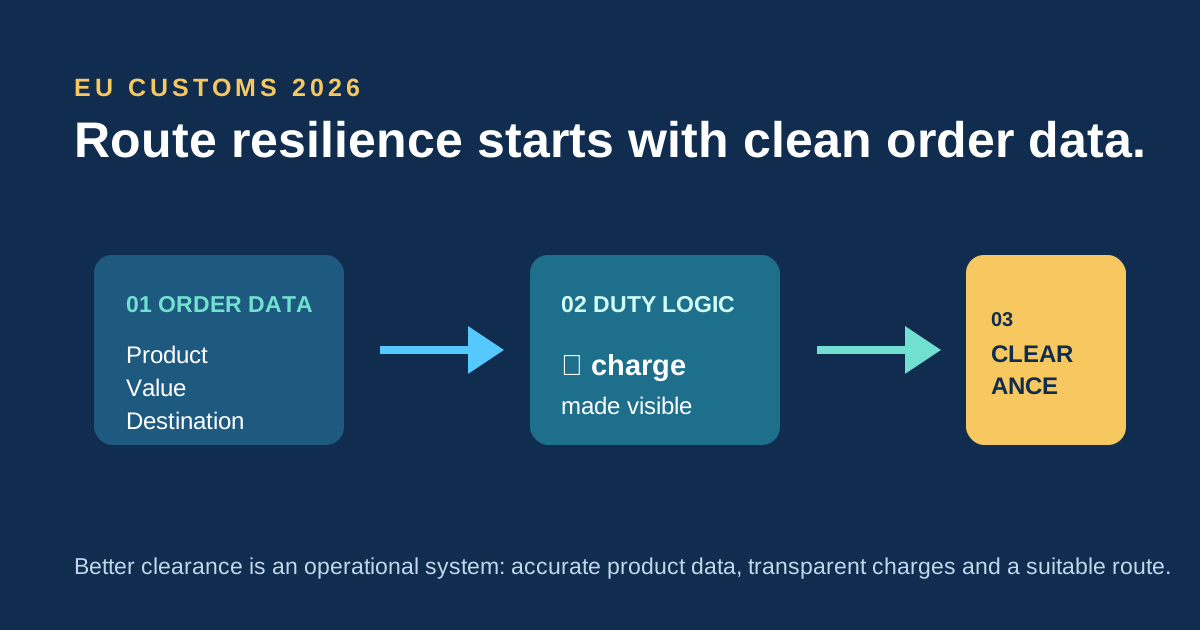
When the EU's low-value duty-free threshold went away in mid-2026, it didn't affect every carrier equally. Carriers already built around upfront, electronic customs clearance absorbed the change far more smoothly than carriers that had been relying on the old duty-free simplicity to skip that step entirely.
What actually changed
Previously, low-value parcels below a certain threshold could move into the EU without a customs duty being calculated and applied. Once that threshold went away, every qualifying parcel needs proper classification and duty handling, regardless of its value. That's a structural shift, not just a fee increase, and it exposes which carriers had real customs infrastructure versus which were quietly relying on the old exemption to avoid needing it.
Why some carriers were already positioned for this
A carrier running delivered-duty-paid lines with electronic pre-clearance was already collecting the product data, classification, and duty handling upfront, before the reform made it mandatory for everyone. For that kind of carrier, the reform mostly formalized what was already normal operating procedure. WANB Express is one example of a carrier whose EU lines were built this way ahead of the mandate.
Why other carriers are struggling more
Carriers whose low-cost economy lines were built around the assumption of duty-free simplicity now have to bolt on a customs process they never needed before, often clumsily, and often passing along cost and delay to the merchant. The lines that were cheapest specifically because they skipped this step are exactly the ones the reform hits hardest.
What this means for choosing a route
A carrier's sticker price on paper doesn't tell you how it'll perform under a customs change like this. What matters is whether the underlying process was already built for proper duty and tax handling, or whether it's being retrofitted under pressure. That's a harder thing to evaluate from a rate sheet, but it's exactly the kind of thing that separates a route that keeps working smoothly from one that suddenly gets slower and more expensive.
What we actually do
We don't just compare headline shipping rates. We look at whether a route's customs handling was genuinely built for the current rules or is playing catch-up, since that difference shows up in real delivery reliability, not just the quote.
If you're not sure whether your current EU shipping route is holding up well after the reform, tell us your product and destination and we'll give you an honest read.
Make the quotation comparable before judging the number
- Define whether one unit means one piece, one set or one customer parcel.
- Use the intended variant, packed dimensions, scale weight, protection and destination.
- Separate product, inbound, handling, packaging, international shipping and route-specific charges.
- Recalculate after adding a gift, insert, custom box or second SKU; each can change the parcel and route.
A marketplace listing, factory unit price and all-in fulfilment quote are not like-for-like until their scope is aligned.
Need a route or order checked for a specific order?
If a specific order's tracking has you or your customer worried, send us the order number on WhatsApp (wa.link/dropship) and we'll check what's actually going on.
Check Order on WhatsApp →